
By Shana-Tara O’Toole | Due Process Institute | President and Jeremiah Mosteller | Policy Counsel
The events of 2020 have caused many in our country to feel a significant level of uncertainty about the future—our health, financial stability, and safety. But this type of uncertainty is felt by those exiting our justice system every day as they seek a second chance to become productive members of our society again. They face a significant uphill battle to restoring their family, reputation, and financial future.
This year has presented us with many opportunities to improve our criminal justice system. The latest: a new bipartisan bill introduced to help remove some of the uncertainty faced by individuals exiting our federal criminal justice system.
The Impact of Federal Drug Crimes on Racial Justice
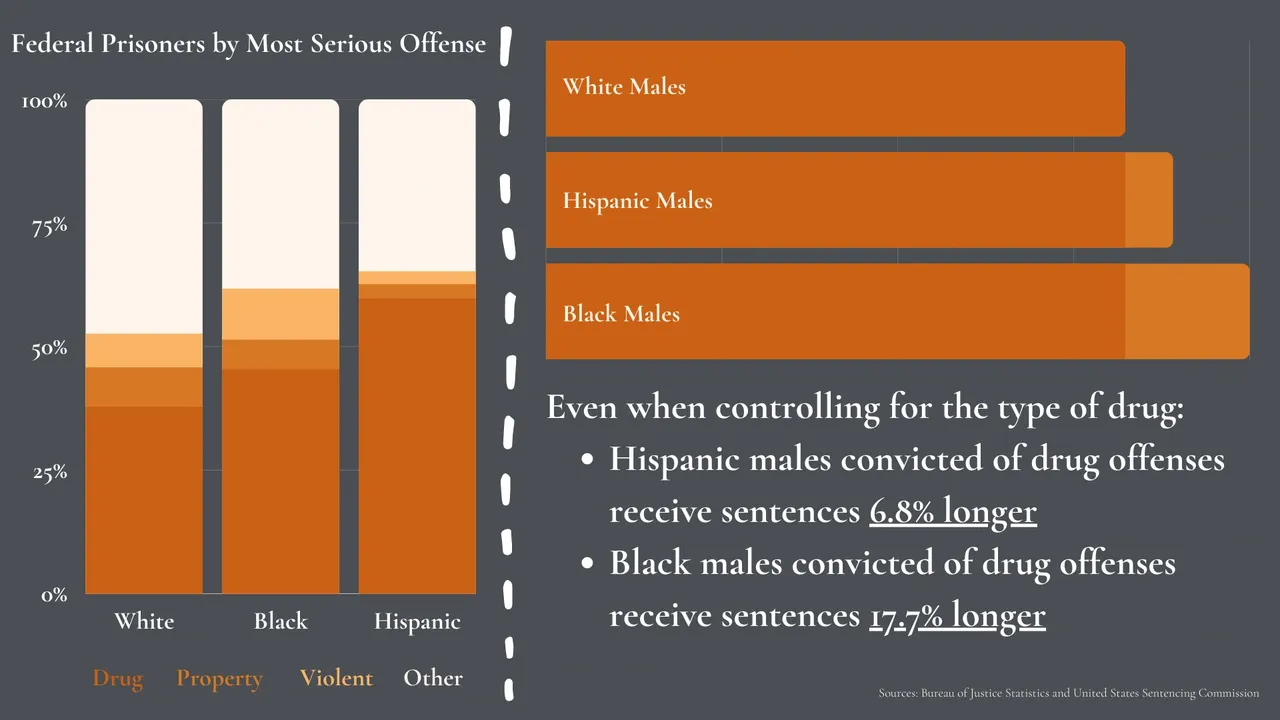
Each year our federal court system hears approximately 25,000 cases for those charged with drug offenses. More than 47 percent of those incarcerated in our federal prison system are there because of a drug conviction. If you look under this baseline data, you quickly discover that the enforcement of our federal drug laws has a disparate impact on different communities. When you break down our federal prison population by offense type and race, you see that Black and Hispanic individuals are more likely to be incarcerated for drugs than White individuals in the federal system. We also see a significant disparity in the length of sentences imposed for drug offenses depending on an individual’s race, despite research consistently indicating that future recidivism is not largely impacted by race alone.
Incarceration Has a Long-Term Impact
One of the many challenges to improving our criminal justice system is the significant societal and legal barriers these individuals face upon returning to their communities. More than 70 million Americans are left without an opportunity to escape the shadow of their worst mistake because of their criminal record. They face social stigma from potential employers, landlords, and community members as well as over 44,000 specific legal barriers that bar them from securing meaningful employment, securing suitable housing, and supporting their family. These barriers significantly contribute to almost half of the individuals exiting our federal justice system being rearrested within just eight years.
A recent report from the Brennan Center for Justice is the first to truly quantify the negative financial impact of a criminal record. This report finds that individuals who are formerly imprisoned see their average annual earnings reduced by 52 percent, whereas those with a felony or misdemeanor conviction but not imprisoned will see their annual earnings decline by 22 percent and 16 percent respectively. This results in an aggregate loss of $327 billion in earnings each year. It is clear that these barriers are harming our communities, local economies, and families. They only perpetuate poverty, exacerbate inequality, and prevent individuals from achieving their full potential.
An Opportunity for A Second Chance
The bipartisan Kenneth P. Thompson Begin Again Act sponsored by Reps. Hakeem Jeffries (D-NY) and Van Taylor (R-TX) is a positive step towards removing many of the barriers to restoration faced by those with a criminal record.
Unfortunately, current law limits relief to individuals convicted of certain low-level drug crimes who were under 21 years of age at the time they were arrested. This bill seeks to expand this limited federal expungement mechanism for simple possession of a controlled substance by eliminating the age limitation of 21 years old. Under the bill, any first-time offender found guilty of simple possession would be eligible for expungement regardless of age.
This revision to existing law makes good sense. We understand the good intentions of the original legislation; it was developed as a way to forgive “youthful indiscretions.” But in reality, people engage in forgivable judgment errors beyond the age of 21 and current law should reflect that. After all, if the conduct was benign enough to expunge for a 21-year-old, is it so radically different for a 23-year-old? Or a 45-year-old?
This reform would align federal law with the policies currently adopted in many states after leaders in these jurisdictions have realized the harm posed by barriers to success for individuals with a criminal record. During 2019 alone, 31 states adopted more than 67 reforms to their expungement or sealing laws to assist individuals in returning to their lives and communities as productive citizens with a chance to start fresh. Adopting the Begin Again Act would position the federal system as an example for states that have not yet reformed their laws in a similar manner as the First Step Act has spurred state reforms across the country.
The Begin Again Act also reflects a growing awareness among researchers and experts that expungement is an evidence-based policy option that can improve public safety. A recent article in Harvard Law Review found that the relief provided by expungement reform in Michigan had a significant impact on an individual’s likelihood of committing a future offense and also had a positive benefit on the recipient’s future employment and salary. This study is affirmed by a growing body of research supporting the positive benefits of expungement for public safety as well as our local economies.
Future Reforms Can Build Upon This Bill
More can certainly be done in this space. Even the existence of a simple arrest–without a conviction or confession–can have a significant impact on someone’s ability to secure meaningful employment or adequate housing. We believe that Congress should consider adopting an automatic expungement or sealing mechanism that applies to arrests, acquittals, and other non-conviction records. States like Pennsylvania, Utah, and New Jersey have successfully adopted these types of solutions in recent years. We should also have a critical, broader conversation about the social value of imposing a permanent scarlet letter on even those who have been convicted, given the large body of research that shows that, after a certain period of time, someone’s likelihood of committing another offense is no higher than someone without a criminal record.
But even without those measures, Congress should advance the bipartisan Begin Again Act given its potential to help more individuals acquire a realistic second chance This bill would be an excellent way to remember Kenneth P. Thompson, Brooklyn’s first Black District Attorney who was known by members of his community as a reformer before reform was popular. He took significant steps in his own work to ensure individuals were not unnecessarily burdened with a criminal record and this change in federal law would honor his fight for true justice.
Groups from across the political spectrum including American Civil Liberties Union, American Conservative Union, Americans for Prosperity, FreedomWorks, Justice Action Network, JustLeadershipUSA, NAACP, National Association of Criminal Defense Lawyers, National Employment Law Project, Prison Fellowship, Right on Crime, and the Safer Foundation are partnering with us to advocate for these reforms. This broad support should make these reforms a no-brainer for Congress to hastily advance to a President that is fully supportive of second chances in the time we have left during this legislative session.
For more information about this bill, see Due Process Institute’s statement about its introduction and our coalition letter to support the bill’s introduction.