

There’s already a worker shortage, and it’s just going to get worse.
By Jason Pye | Due Process Institute | Vice President
There are two trends occurring in the United States that few lawmakers are taking seriously: American businesses need workers and Congress is not doing nearly enough to pave a path for opportunity for people who have a criminal record. Meanwhile, the future of the American workforce is getting lost in the hyper-partisan squabbles that make even renaming a federal building difficult in the midst of never-ending culture wars that substitute outrage for solutions.
The first trend that lawmakers are ignoring is the number of job openings in the economy compared to the number of unemployed persons. The United States has seen a surplus of job openings in 75 out of the past 92 months. From January 2018 through February 2020, there were an average of 1.002 million more job openings than unemployed persons. From January 2023 through February 2025, there were 1.996 million more job openings than unemployed persons. Now, the context behind this is the recovery from the pandemic. Starting in January 2024 and running through February 2025, there are 968,000 more job openings than workers to fill them.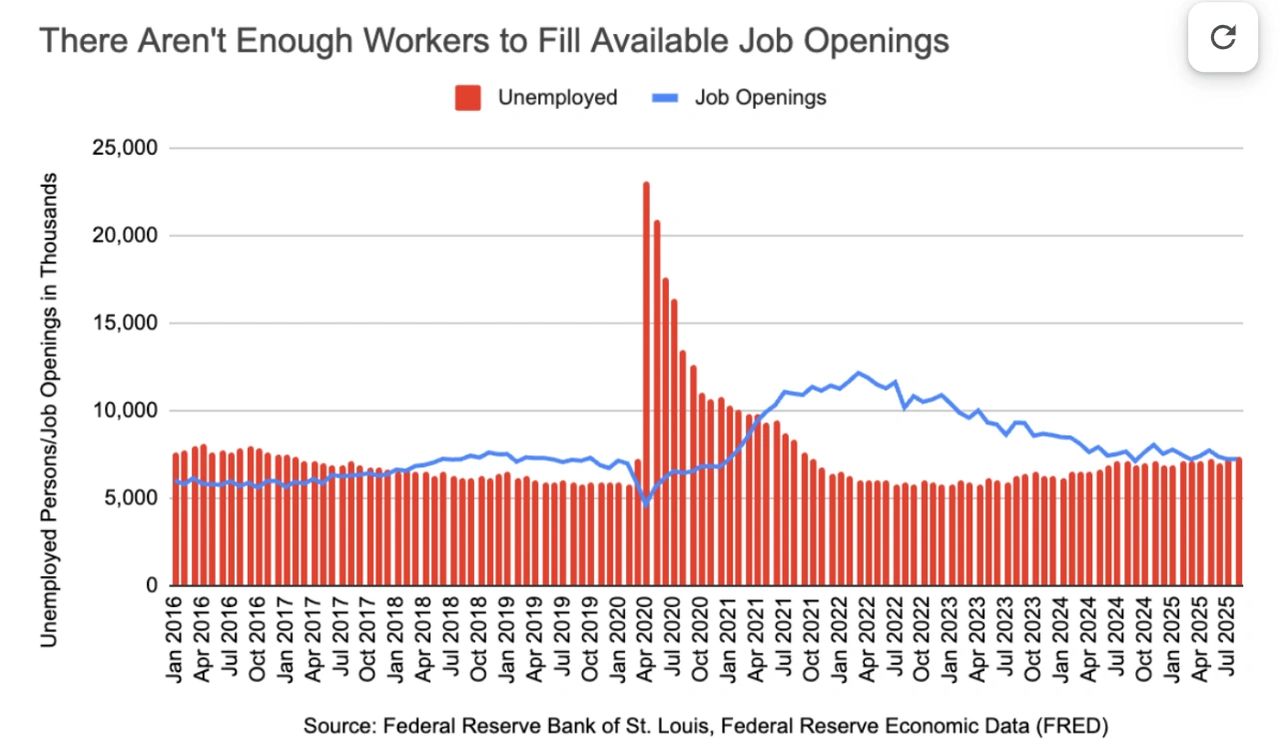
Admittedly, the number of openings began to decline in June 2024 and, in July and August, there were more unemployed people than job openings. It is still too early to say, but there may be more economic uncertainty ahead. That could mean decreases in job openings and increases in the number of unemployed persons. However, when the economy recovers, Congress must ensure that policies are in place to get people back to work as quickly as possible.
According to a publication from the Congressional Budget Office (CBO) released in September, the native-born population will have more deaths than births in 2031—a little over five years from now. This is a revised version of a similar report released in January. The previous report showed more deaths than births in 2033. The CBO attributed the shift primarily to lower net immigration and declining fertility rates. The projection of more deaths than births among the native-born population is an alarming economic indicator that Congress must address.
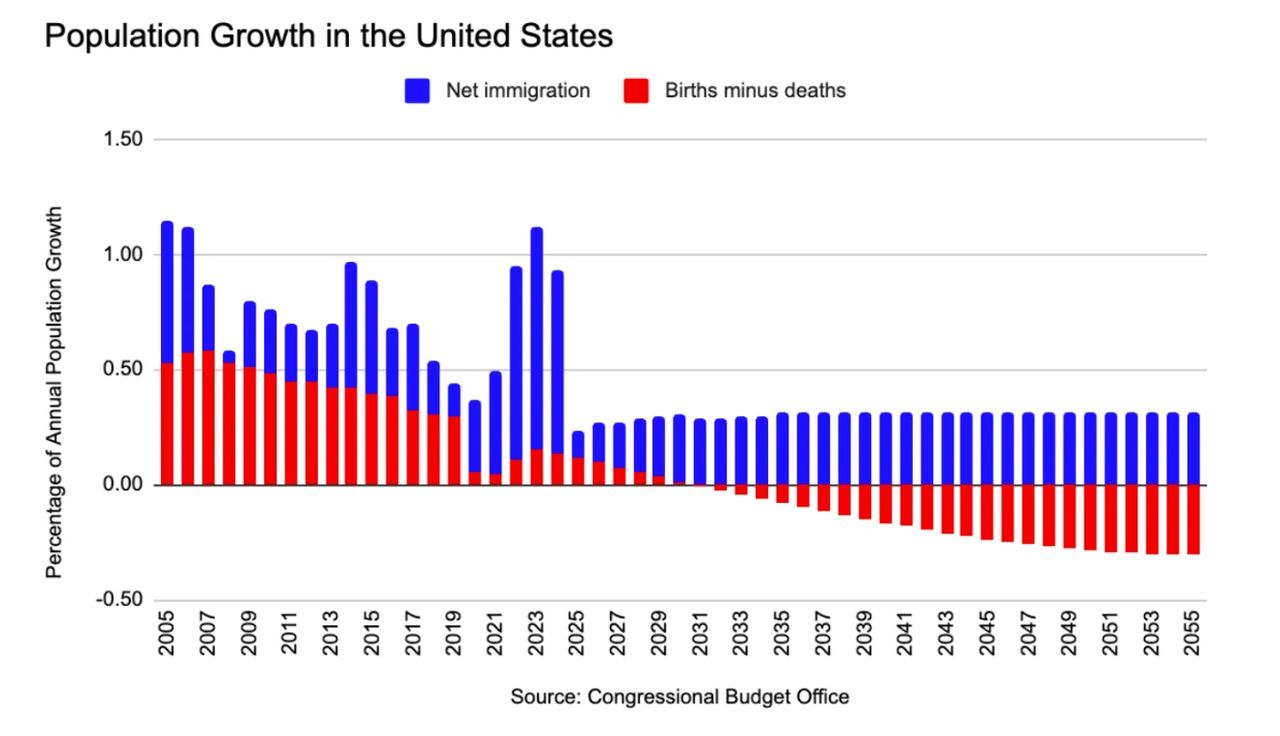
An aging and shrinking native-born population, combined with a persistent labor shortage, means the United States can no longer afford to sideline millions of employable adults because of criminal records. The math alone doesn’t allow it.
Failing to maximize the workforce will compound every existing weakness in the American economy. A shrinking labor pool means slower growth, weaker tax revenue, and higher per-capita costs for entitlement programs that depend on a growing base of workers. The Congressional Budget Office already projects that federal debt will reach 116 percent of GDP by 2034 if current trends continue, primarily driven by mandatory spending and net interest. Without a sufficient number of working-age adults, productivity and output will stagnate while obligations rise. The result isn’t just a fiscal problem, it’s a societal one. When businesses can’t find the workers they need, innovation slows, consumer prices rise, and the ladder of upward mobility collapses. The economy cannot function efficiently when millions who are willing and able to work are prevented from doing so by unthoughtful policy choices.
If the United States is facing a shrinking labor supply, the logical solution should be to expand the pool of employable workers. Yet millions of Americans who could fill open positions are blocked from doing so by a criminal record—often due to offenses that are decades old or technical violations unrelated to public safety.
Roughly 1 in 3 adults in the United States—70 million to 100 million people—have some form of a criminal record. That’s more than the entire populations of California, Texas, and New York combined. Even a minor record can automatically disqualify someone from jobs, housing, and occupational licensing, creating a cycle of unemployment and underemployment that depresses economic output and keeps families in poverty.
A 2022 report from the Brennan Center for Justice found that people with felony convictions face an average 52 percent reduction in annual earnings, even after controlling for education and experience. The lost GDP from this exclusion is estimated to be between $78 billion and $87 billion annually, according to the Center for Economic and Policy Research.
The economic case for reform is clear. Record-sealing and expungement policies have shown measurable success in states that adopted them. In Michigan, researchers from the University of Michigan Law School found that individuals who received expungements experienced a 23 percent wage increase within one year and had extremely low recidivism rates—lower than even those of the general population.
Federal legislation—such as the Clean Slate Act, H.R. 3114 and S. 1580; the Safer Supervision Act, H.R. 5883 and S. 3077; and the Fresh Start Act, H.R. 3111 and S. 2590—would solve a lot of these issues on a national level. The Clean Slate Act would automate the sealing of certain federal records after a defined period of rehabilitation, ensuring that old convictions don’t create unnecessary lifelong barriers to work. The Safer Supervision Act would allow judges to shorten or terminate supervised release for individuals who pose minimal risk to their communities, thereby allowing probation officers to focus on those who truly require closer oversight. And the Fresh Start Act would incentivize states to adopt automatic record-sealing systems by providing federal grants for implementation — an approach modeled on successful state-level reforms that have already cleared millions of records.
A tight labor market demands pragmatic inclusion. The business case is straightforward: second-chance hires have higher retention rates and lower turnover costs. The U.S. Chamber of Commerce and the Society for Human Resource Management have noted the benefits of second-chance hiring and business practices. Corporations like J.P. Morgan Chase and Walmart, among many others, have second-chance hiring practices in place. When employers give people a fair shot, they aren’t just doing the right thing—they’re solving a workforce problem Congress refuses to confront.
The numbers tell the story. America’s future growth depends not just on technology or immigration, but on people—millions of them—who are already here, ready to work, and just need a system that allows them to.
A nation that wastes human potential cannot sustain growth or fiscal stability. The coming decade will test whether the United States can adapt to a shortage of workers as quickly as it once adapted to a surplus of opportunity. Capital and technology remain abundant; people do not. The answer isn’t another program or slogan—it’s removing the barriers that keep capable adults on the sidelines. Building a truly inclusive economy isn’t about leniency; it’s about leverage. Every person who reenters the workforce adds to the nation’s productive capacity, reduces dependence on public spending, and strengthens the foundation of American prosperity.