
By Ron LeGrand | President & CEO | The LeGrand Group Consulting, LLC
Julian Edward Roosevelt Lewis, Elijah McClain, Rayshard Brooks, George Floyd, Breonna Taylor, Eric Garner, Tamir Rice, Sandra Bland, Trayvon Martin, Ahmaud Arbery, Mike Brown, Freddie Gray, Philando Castile, Tony McDade, Atatiana Jefferson, Botham Jean—all have been senselessly murdered, along with so many others that I lose count of those who have their lives at the hands of law enforcement.
But it is not just police officers who have brutally taken Black lives. Let us also acknowledge that this summer—June 17, 2020—marks five years since the horrific murder of nine worshipers at the Mother Emanuel AME Church in South Carolina by an avowed white supremacist who attended Bible study with his victims prior to opening fire upon them. In fact, the killer had targeted that church because of its history as one of the oldest Black churches in our country and one that had been the site of many civil rights organizing efforts. These lives, and so many more, have been extinguished as a result of the color of their skin.
I am a 70-year-old Black man who is tired, angry, and enraged by the unending violence and indifference toward the lives of Black people, regardless of gender and age. As a father of six Black men, four daughters (by marriage), and grandfather of eight boys and girls with yet another grandchild on the way, I am hurting, anxious, even fearful for their safety. In addition to being a Black man at the head of a beautiful family, I am a man who owns his own business. I am a man who has spent decades of my life serving others through my nonprofit work and volunteerism. I have worked in the C-suite of Fortune 500 companies as a diversity and inclusion expert. I have spent years focusing on criminal justice reform as a lawyer working for the U.S. House of Representatives during our nation’s first Black Presidency. I have worked under the leadership of Joseph Biden—whom I believe will serve as this nation’s next President. I have served as a federal law enforcement officer with a badge and a gun. And importantly, it is all of these experiences that fuel my sadness and my anger.
For much of my 70 years, I have tried to believe that we, as a nation, are capable of being better than this, better than the savagery that we are forced to witness on an almost weekly if not daily basis. But I am haunted by the sight of a police officer kneeling on George Floyd’s neck while that officer calmly, callously and with apparent indifference has his hands in his pockets and ignored the pleas of those watching, imploring him and the other officers to “check his pulse” because “he has stopped moving” and Floyd’s nose had begun to bleed. I wept with the knowledge that with his dying breath, this 47-year old Black man called out to his late Momma. Where does such indifference to human life come from? For so long, I have wanted to believe that collectively we are capable of being better than the hatred and anger that consumes a subset of individuals. I have held faith in the belief that we are better than this deplorable disease called racism.
But are we?
I think about Walter Scott, an unarmed black man, who was shot and killed in North Charleston, South Carolina by Michael Slager, a white North Charleston police officer. Slager had stopped Scott for a non-functioning brake light. Slager was charged with murder after a video surfaced showing him shooting Scott in the back while Scott was fleeing. Thankfully, there was video that contradicted Slager’s report of the incident. As a Black man—who also happens to have a law enforcement background—I remember that part of my training in which we were told to never fire a weapon at a fleeing suspect. Why? Because that person no longer poses a threat and you might mistakenly hit an innocent bystander. Case in point: in the shooting of Rayshard Brooks on Friday, June 12th of this year, stray police bullets struck a bystander’s car with two children inside.
The police motto used to be “To Serve and Protect.” When did that change?
We used to believe that we could tell our children that police officers were there to help us, to protect us, to keep us safe. When did that change?
What do we tell our children now? How do we convince them that police officers are there to help them when there’s a need? How do we tell them that is still the case when they are witnessing police brutality almost daily? How do we tell them that is still the case when the President of the United States uses the police to clear a crowd of peaceful demonstrators away with tear gas, pepper spray, and rubber bullets so that he can pose in front of a church with an upside-down Bible?
Can they still be trusted? Can they still be trusted?
Can I trust that if any of my family is pulled over by a police officer on the side of the road that they will be treated with the professionalism and human decency that should be expected?
This country has a long and deep-seated hatred and, I suspect, fear of Black people and Black men in particular—so much so that what we once called “driving while Black” has simply evolved into “LIVING WHILE BLACK.” Truthfully, history shows that there has never been a day when it was truly safe for Black folks to just be, to live without the anxiety of the next evil act. The reality is that it is no longer just our sons who need to get “the Talk;” it is our daughters as well. Sadly, there is gathering evidence that young Black girls are among the most harshly disciplined and overcriminalized student groups in the country. As much as many would like to believe that we, as a nation, have made progress in our journey to end discrimination, racism, and achieve equality and justice for all, the reality is that we have so much further to go.
I have personally witnessed how people can change when they are carrying a badge and gun. On more than one occasion I had to intervene when my partner at the Drug Enforcement Agency decided to slap an individual around AFTER the person was handcuffed. A weapon, combined with an emboldened sense of utter authority, can turn a person into a brute. Over time, I have become very concerned over the increased militarization of America’s police forces —militarization that can only be for one purpose: to suppress through the use of armored personnel carriers, assault rifles, submachine guns, flashbang grenades, grenade launchers, sniper rifles and Special Weapons and Tactics (SWAT) teams. This aggressive style of law enforcement aims to suppress rather than de-escalate. It is the inevitable violent progression of what began with our law enforcement’s use of attack dogs during the start of the Civil Rights movement.
According to one recent report, “Militarization makes every problem—even a car of teenagers driving away from a party—look like a nail that should be hit with an AR-15 hammer.” Not surprisingly, a 2017 study showed that police forces that received military equipment were more likely to have violent encounters with the public, regardless of local crime rates. A 2018 study found that militarized police units in the United States were more frequently deployed to communities with large numbers of Black Americans, even after controlling for local crime rates. None of us should be surprised that our police will use the weapons that we give them, nor be surprised they will be used suppress and brutalize Black Americans.
My 96-year-old mother grew up in Jim Crow North Carolina and as a child, I vividly remember traveling from New Jersey with her and my uncle to visit relatives in the South. Part of that memory is seeing the signs at the service station restrooms that read: “Men,” “Women,” and “Colored.” I remember that we had to pick up the hose from the ground to quench our thirst instead of drinking from the water fountain. Perhaps the most striking thing was that billboard—much like this one—that let us know where we were:
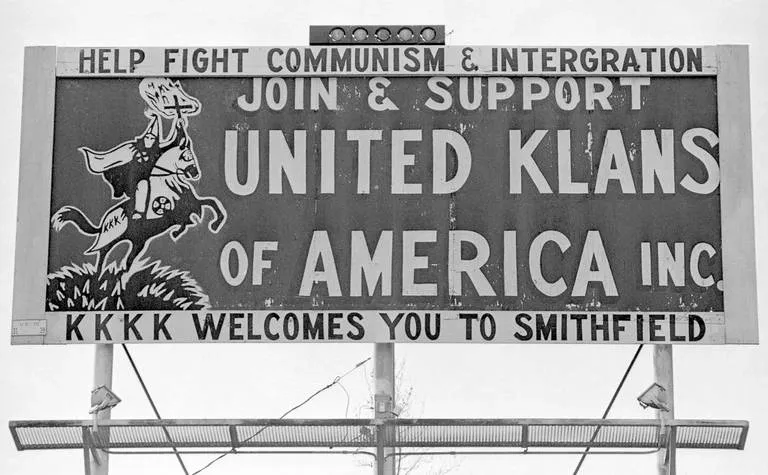
Sadly, while there has been some progress, so much more remains to be done. The KKK still exists and we have to think back less than 3 years ago to August 2017 to the ugly activities of white supremacists in Charlottesville, VA, where not only was racism on full display, but the President of the United States failed to acknowledge white supremacists and neo-Nazis as belonging to hate groups. Nor would the President use the term “domestic terrorism” to describe the attack. While we might no longer have giant public road signs boldly announcing white supremacy, there are still plenty of other signs of its pernicious existence.
This must end.
This country’s legacy of racism, indifference, hatred, and police brutality must end. It is up to us to elect local, state, and national political leaders who have the courage to do what is necessary. Government officials who wish to lead our communities must step forward, regardless of party affiliation or race, and acknowledge and address the pain and deep wounds in our country. But it is not just our political leaders who must do this—those who lead our businesses, our schools, our churches, and our jails must not continue to ignore our country’s history of racial and economic injustice. We need them to address these issues with honesty, with haste, and with tenacity—calling out and rejecting racism in the language and actions of others no matter who they are: your friend, your family, your neighbor, your colleague, your boss, your police chief, your Senator, your President.
As for the specific reforms we need these leaders to create and support, we need so many that it is hard to focus on where to start, but I will try:
- We need investment in greater opportunities for our children.
- We need to end unfair and punitive policies that have targeted our Black boys and girls and children of color in our schools.
- We must reform the laws that have led to the excessive, harsh, and unjust sentencing of Black men and women and other people of color.
- We need to provide social, medical, and mental health services needed in our communities.
- And yes, we need significant policing reforms.
We must hold law enforcement officers accountable for their abuses and use of excessive force. We need to understand the extent to which abusive officers are a product of toxic or racist policing culture or leadership or whether they came into the force that way. We need more effective screening of applicants for police departments and a significant retooling of police training. Where did the department fail in the recruiting and screening of these officers? Did they screen for possible PTSD, racist views, or even hidden biases? In addition, those who purport to protect our communities must live in our communities, be a part of our communities, and be personally invested in our communities as residents who truly care about the welfare of their neighbors rather than outsiders who lack familiarity and compassion for those they serve. Those whom our society gives so much power to by way of a badge and a firearm must be entrusted not to abuse that power. I believe that just as I believe that the majority of the men and women in law enforcement are truly dedicated to protecting and serving their respective communities.
I am encouraged by the talk of reform legislation, but I am mindful of this reality: policy and legislation are only words on paper. It is the ACTION that matters, along with ATTITUDES! If attitudes do not change, we are left with words on paper and the same decades-long behavior. Real change must come from WITHIN each of us. It has begun with all those who have taken to the streets to march and protest. Let each one of them pledge to take responsibility for teaching at least one more person what they have experienced and learned. Let each person who hasn’t marched but whose consciousness regarding race has been awakened during this time take the same pledge. If our communities can do that, we will go a long way toward achieving not only a reduction in unnecessary police violence, but we will have done the more important work of reforming the hearts, minds, and deeds of our fellow humans.
We’ve got a lot of work to do and it can be done if we ALL have the will to do it.
But for now, the list of tragedies continues to grow and my heart aches with each occurrence. My anger grows with each report of police misconduct as do my fears of what could happen to the next innocent person and those fears even extend to my loved ones.
I also fear we might get to a point where the people will say, “Enough!” and begin to retaliate. Is that what happened with the recent ambush of sheriff’s deputies in Los Angeles? I don’t know anything about those two deputies except that they were still relatively new on the job. Was merely wearing a uniform and sitting in that patrol car the offense that warranted them being seriously wounded? And so I hurt for the good men and women of law enforcement as well because I fear that they might be unfairly targeted. I’ve known plenty of individual officers who are truly dedicated to protecting and serving the public.
How do we bring an end to all this violence?
I surely don’t have all the answers.
But let us begin.