
By Jason Pye | Due Process Institute | Vice President
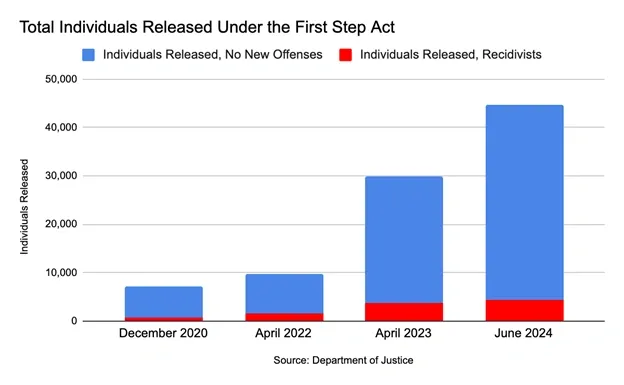
In June, the Department of Justice released its fourth annual report on the landmark sentencing and prison reform law—the First Step Act of 2018. The report explores the implementation of the First Step Act and provides detailed data on recidivism among the law’s beneficiaries.
A Reminder of the First Step Act’s Reforms
The First Step Act included provisions that provided immediate relief to individuals serving time in federal prison. For example, section 102 restored Congress’s original statutory intention to provide people with the opportunity to earn up to 54 days of “good time” credit during each year of a person’s prison sentence and, importantly, made the change apply retroactively. Section 404 applied the Fair Sentencing Act of 2010 retroactively. (As a reminder, the Fair Sentencing Act reduced the sentencing disparity between crack cocaine and powder cocaine offenses from 100-to-1 down to 18-to-1.)[1]
The First Step Act also introduced earned time credits (also known as “First Step time credits” or “FTC”) that individuals who are assessed as minimum and low risk can use to transition into home confinement or a residential reentry facility to serve the remainder of their sentence. This type of credit is earned by completing programming or engaging in certain designated “productive activities” designed to reduce the risk of recidivism. While this change was not retroactive, it still provides many individuals with new opportunities to work towards rebuilding their lives once they are no longer incarcerated.[2]
Incredibly Low Recidivism of Those Released Under the First Step Act
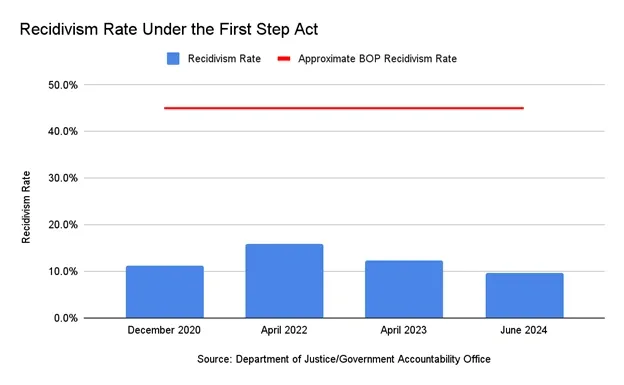
As of January 2024, 44,671 individuals have been released from the custody of the Federal Bureau of Prisons (BOP) under the reform provisions passed as the First Step Act. According to the DOJ’s most recent report, only 4,326 of these individuals have been arrested for a new offense. While of course society’s wish is that those released from BOP custody would never again have involvement with the criminal legal system, that is unrealistic. The good news is that, five years since its passage, First Step Act relief recipients have an objectively low recidivism rate of only 9.7 percent.
To put this incredibly low recidivism rate in context, BOP boasts about its overall recidivism rate of “around 43 percent.” (Interestingly, the Government Accountability Office determined in a March 2023 report that the BOP’s recidivism rate is actually closer to 45 percent. The fact that First Step Act releasees have a drastically lower rate than that is something everyone should take notice of.
The First Step Act’s Risk Assessment Tool
The First Step Act authorized the creation of a risk assessment tool to determine the risk of recidivism of each individual in the custody of the BOP. The risk assessment tool under the First Step Act, PATTERN, is used to determine the specific needs of the individual and assign a level of risk for recidivism. Every individual in BOP custody is assessed, and periodically reassessed, with PATTERN. (I note that risk assessments certainly are not without controversy, since any fixed system purporting to assess “risk” of an individual on the basis of personal characteristics can be unfairly impacted by existing racial, ethnic, economic, educational, and social disparities.)
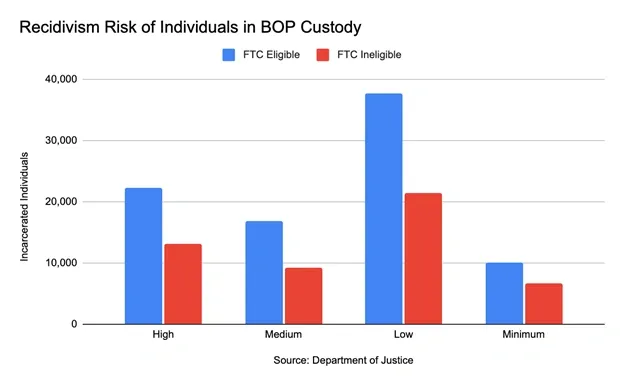
The data available so far from the BOP suggests that the First Step Act’s risk assessment has been useful in predicting recidivism insofar as it applies to those it deemed minimum or low risk. Minimum and low-risk individuals comprise about 55 percent of the assessed prison population and about 88 percent of individuals released through the First Step Act.[3] The DOJ’s report reveals that only 2.8 percent of individuals assessed at minimum risk and only 5.6 percent of individuals assessed at low risk were rearrested. Unfortunately, we cannot know whether individuals who were assessed at a higher risk level would show correlated rising recidivism rates or whether they might have continued the trend of low recidivism risks since no one assessed at those levels was released under the First Step Act’s reform provisions.
Other Interesting Data to Note from DOJ’s Recent Report
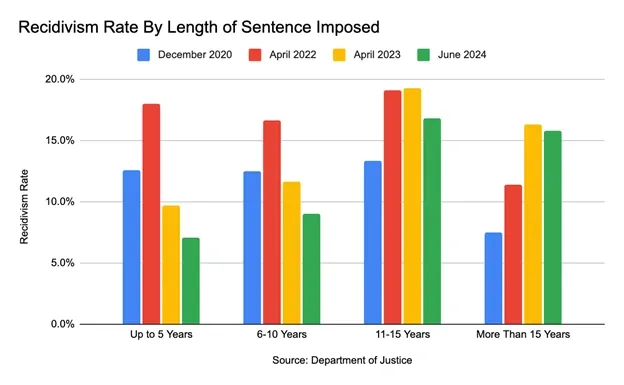
I think it is important to highlight other aspects of the data the report provides, such as the recidivism rates of sentences imposed.[4]According to the report, the recidivism rate of individuals who were given sentences of up to five years is 7.1 percent. This cohort represents almost 53 percent of all individuals in custody. DOJ’s report indicates that the recidivism rate rises with the length of sentences imposed; essentially, the longer the sentence, the higher the likelihood of recidivism.
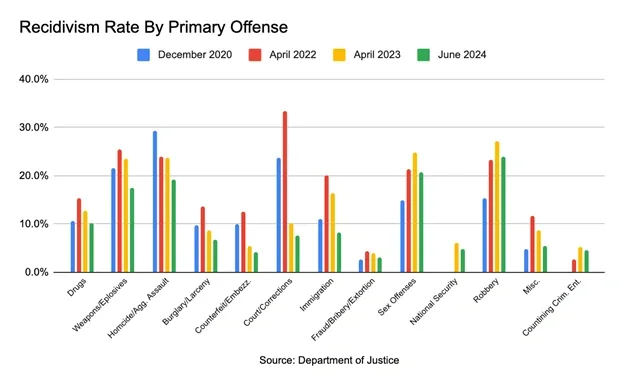
The report also gives us data on recidivism rates by primary offense. Individuals incarcerated for robbery (23.9 percent), sex offenses (20.7 percent), homicide or aggravated assault (19.2 percent), and weapons or explosives (17.5 percent) had the highest rates of recidivism. Individuals incarcerated for drug offenses represent a whopping 57 percent of the prison population; however, the recidivism rate for these individuals is only 10.2 percent.
Conclusion
The DOJ’s most recent report regarding those released under the First Step Act’s provisions is good news. From this snapshot, it is clear that the reforms under the First Step Act were good public policy. Obviously, more years of data will ultimately give us an even better picture of how successful the First Step Act was, but it is meaningful that five years in, the news is overwhelmingly positive.
Members of Congress should take note: carefully crafted bipartisan criminal justice solutions move America forward. And there are plenty of reasonable “next steps” Congress can take to build upon the First Step Act’s success. One of the most obvious priorities should be to relieve those released from incarceration (as well as those arrested, but not convicted) from unfair and unproductive burdens that prevent them from finding employment, receiving an education, and qualifying for safe housing. These impediments significantly hamper efforts to rebuild lives, heal families, and enhance our communities.
Bipartisan “second chance” legislation like the Clean Slate Act—which provides an opportunity to seal certain criminal records–and the Fresh Start Act—which incentivizes states to pass automatic record-sealing and expungement laws—are critically important to removing unnecessary barriers for those seeking to lead successful lives and contribute meaningfully to our economy. We need these individuals in our workforce. With our society growing older, we need to ensure there’s opportunity for everyone in our economy, and that includes the millions of Americans with a criminal record.
[1] See “The History of Attempts to Reform the Disparity” for more information on the penalties for crack cocaine and the reforms of the Fair Sentencing Act available here.
[2] Under the First Step Act’s earned time credit system, only individuals who are deemed at minimum or low risk of recidivism can cash in time credits for placement into prerelease custody. Individuals who are assessed at medium and high risk must reduce their risk of recidivism before they can use their time credits. Additionally, not everyone in BOP’s custody is currently eligible to use time credits. The First Step Act excluded more than 60 offenses from eligibility for earned time credits. As of January 2024, roughly 37 percent of people in BOP’s custody were ineligible for earned time credits. (However, this percentage excludes nearly 4,200 people whose eligibility has not yet been determined as well as 2,500 D.C. Code offenders.)
[3] The assessed prison population are people whose recidivism risk has been adjudicated via PATTERN and their time credit status has been determined. This excludes DC Code Offenders and people whose FTC eligibility had not yet been determined (“FTC Unassigned”). Together, DC Code Offenders and FTC Unassigned are less than five percent of people in BOP custody.
[4] The report also provides data relating to individuals based on the length of the sentence served, but there are not remarkable differences between the two data sets.