

By Jason Pye | Due Process Institute | Vice President
Let’s start up front with this: violent crime is down. This is a fact that is very easy to grasp by looking at the data for 2022 and 2023 (the latter of which is the most recent data). In addition, the preliminary data for the first six months of 2024 show continued declines. There’s no question that there’s still work to do in areas where high rates of crime–which tend to correlate with high rates of poverty and a lack of economic opportunity–continue to persist. But let me say it one more time for the folks in the back: violent crime rates are down.
But it’s an election year, and, of course, that means that those desperately vying for political power in D.C. operate in a space where facts are mere inconveniences. The masters of misinformation don’t care about facts. Misinformation and misinformation are the means to win.
Here are some of the more recent examples. In July, Speaker Mike Johnson (R-LA) gave a speech in which he said, “We can’t survive the dramatic increases in violence, crime and drugs that the Democrats’ policies have brought upon our communities.” The words of Exodus 20:16 are relevant here: “You shall not bear false witness against your neighbor.” Still, Johnson’s comments are only one example. The Republican majority on the House Judiciary Subcommittee on Crime called a hearing in September entitled, “The Consequences of Soft-on-Crime Policies,” designed to exploit the issue of crime for political gain. Turn on the TV any night of the week, and you’ll hear a talking head trying to drum up fears about crime to benefit his or her political party.
The violent crime rate in 2023 was second lowest since it peaked in 1991, at 363.8 reported violent crimes per 100,000 inhabitants. (We have to exclude the 2021 data from this because reporting from law enforcement agencies was so poor.) Some may note that the data for previous years were revised by the FBI, specifically pointing to the 2022 figures. Although it’s true that the FBI revised the 2022 figures, the FBI originally reported that the violent crime rate in 2022 was 380.7 per 100,000 inhabitants. There was a downward revision that some conservative pundits have seized on before the FBI updated the 2022 figure to 377.1 violent crimes per 100,000 inhabitants.
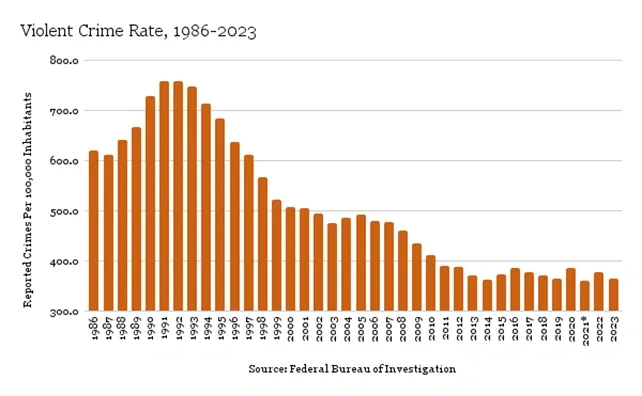
As noted, the preliminary data for 2024 suggests that violent crime will decline again, but we won’t know for certain until next fall, when the data are finalized and publicly released. But none of this should be a surprise. Data collected by the Major Cities Chiefs Association showed declines in instances of violent crime in 69 of the largest jurisdictions in the United States between 2022 and 2023. In total, there were more than 11,400 fewer instances of violent crime between 2022 and 2023. Compared to the first six months of 2023, there were 12,672 fewer instances of violent crime in the same period in 2024.
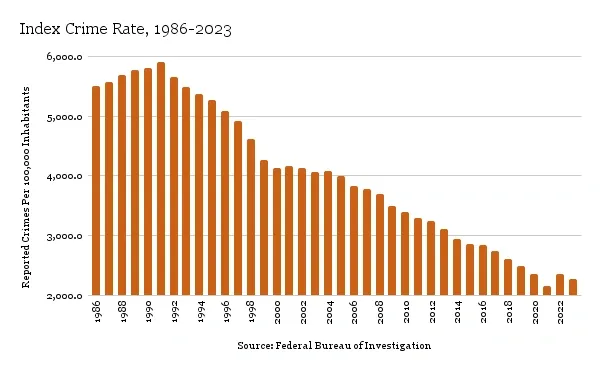
Looking more broadly at “index crime”—violent crime rates plus property crime rates—crime was at its lowest point in 2021. As previously noted, there’s a caveat to that: data in 2021 are murky because only because agencies that reported to the FBI covered only 65 percent of the population. This is the lowest rate going back to 1986. However, participation increased substantially for 2022and 2023 and is on par with previous years.
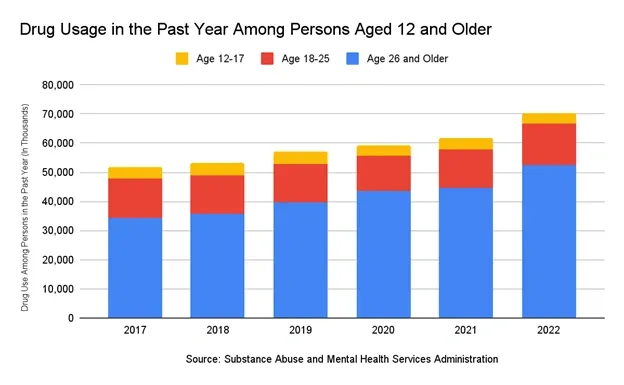
Did violent crime increase during the pandemic? Yes, in 2020, but we need to view that increase in crime in the proper context. We were experiencing a global pandemic that forced many Americans to isolate for long periods of time. The pandemic had a negative impact on Americans’ mental health. We also know there was a spike in drug usage during the pandemic. Data collected by Substance Abuse and Mental Health Services Administration (SAMHSA) show that drug usage in 2020 among adults aged 18 and older jumped from 52.9 million to 66.5 million in 2022. Overall, drug usage increased from 59.2 million in 2020 to 70.3 million in 2022. Additionally, there was an economic downturn during the pandemic, heighted racial tension in the aftermath of the murders of George Floyd and Breonna Taylor among others, heightened instances of hate crime, and increased political violence as well. It isn’t far-fetched to think that any of these factors could have impacted the increase of violent crime. There are likely also additional factors that led to the increase in violent crime in 2020 that haven’t yet been identified.
Lawmakers would be better served working across the aisle to address public safety concerns rather than engaging in fearmongering in an attempt to score political points. The fact is, violent crime has decreased back to pre-2019 levels, which is positive news for our nation. The better news is Americans are slowly beginning to see past the often ridiculous rhetoric and realize that the issue of crime isn’t what some make it out to be. Regardless of who wins the White House and controls Congress, lawmakers should explore bipartisan solutions to reduce recidivism and develop a more rational approach to sentencing rather than continue to push false narratives to Americans.