
By Tray Brown | Due Process Institute | Policy Communications Associate
Background
March 18th is National Public Defender Day and the 59th anniversary of Gideon v. Wainwright [1]–the Supreme Court case that established that the Sixth Amendment’s guarantee of defense counsel is a fundamental right essential to a fair trial and must be provided by states. Since Gideon, there’s been tremendous progress in providing representation for persons accused of crimes who cannot afford to pay for an attorney. However, many localities and states still fall far short in funding public defense and meeting their 6th Amendment due process obligations.
Due Process Institute has highlighted this shortcoming—and the need for a parity in resources between the defense function and the prosecutorial function—in our amicus filings in Allen, et al. v. Edwards. We pointed to the systemic underfunding of public defenders in Louisiana and argued it violates the Sixth Amendment because the amendment “compels the States, when they establish professional prosecutorial and police functions, to allocate sufficient funds for a meaningful defense within the adversarial system.” While there is no doubt that states should provide sufficient funding, it is also important to address how Louisiana got to this critical point in public defense and where the rest of the United States still stands on this vital issue.
Public Defense Funding in Louisiana
Louisiana remains one of the few states that funds its public defenders through the assessment of fines and fees. According to the Sixth Amendment Center, 67% of Louisiana’s public defense budget comes from this source. Funding public defenders with essentially traffic tickets is deeply problematic for several reasons. First, it is not a consistent or predictable source of revenue. Relying on citizens to pay parking tickets in order to fund public defenders seems antithetical to a state’s responsibility to guarantee counsel. Second, in order to properly fund the public defense system, the government needs to reach a certain quota of criminal fines and fees and these penalties end up disproportionately impacting low income communities and communities of color. (Read about Due Process Institute’s work to end or limit certain court related fees and fines.)
Unsurprisingly, the reliance on criminal fees and fines to pay for the state’s public defense services has resulted in chronic underfunding of the state’s public defense system. A 2017 study by the American Bar Association in Louisiana found the state needed nearly 1,500 additional full-time public defenders to deal with the state’s caseloads. At the time, the state had only 363 full-time public defenders. Under such circumstances, even the most dedicated public defenders cannot provide constitutionally adequate representation to the people of Louisiana.
I have witnessed the impact of Louisiana’s inadequate public defense funding firsthand. I worked at Orleans Public Defenders (OPD) in 2014 where the office’s budget, like every other Louisiana public defender’s office, was reliant on fines and fees. While the office was in the midst of a budget crisis, I watched attorneys be furloughed for weeks, which made them unable to meet with clients in jail or represent them in court—leading to an even worse 6th Amendment crisis.
The Lack of Public Defense Funding Is A National Problem
Louisiana may be unique in how it inadequately funds public defense but the systemic underfunding of public defenders is still a national problem. The Bureau of Justice Statistics’ (BJS) most recent data for prosecutorial and public defense funding (adjusted for inflation) shows in simple terms the massive disparity in total state funding:
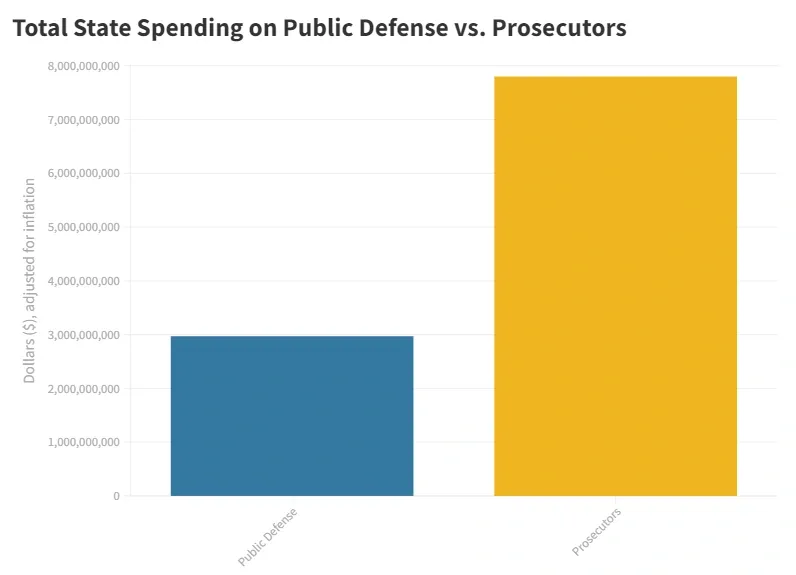
When adjusting the BJS studies from 2007 and 2011 for 2022 inflation, public defense services received $2.92 billion from state funding whereas prosecutor offices received $7.8 billion dollars. You cannot have a fair and just adversarial system where one side has, on average, nearly three times the economic resources. And this lack of parity has serious consequences.
The Consequences of Inadequate and Unequal Funding
One obvious consequence of inadequate public defense funding is the imbalance it creates in a legal system whose fairness is allegedly maintained by the existence of a balanced “adversarial” process. The Sixth Amendment’s guarantee of defense counsel isn’t meaningful if that counsel lacks the resources to present a defense that can effectively respond to the prosecution. In practical terms, the disparity in funding makes it difficult for appointed defense counsel to do such things as investigate, prepare, or interview witnesses, test evidence, hire experts, or review discovery to the same degree that the state’s prosecuting attorneys can.
But perhaps the greatest effect of insufficient public defense funding is it results in overworked public defenders all across the country. In 2017, a public defender taking 80 to 100 cases per week was considered the norm. The National Advisory Commission on Criminal Justice Standards and Goals (NAC) recommends an attorney should take a maximum of 150 felonies per year or a maximum of 400 misdemeanors. A public defender who received 80 misdemeanor cases per week would still intake over 4000 cases in one year. This overload of cases is largely because 60% to 90% of all criminal cases involve defendants who are relying on public defenders, according to the Bureau of Justice Assistance. Adequate funding would enable a public defender office to hire more attorneys to lower their case loads, which would in turn lead to more effective representation of each client.
It has been well-documented that the constitutional right to a trial has been dramatically eroded. It is estimated that 94% of state felony convictions are now the result of plea bargains versus resolution by trial. While not entirely to blame for the problem, this erosion is inextricably linked to the sheer volume of cases assigned to public defenders. Given the time, resources, and preparation, it would be impossible for defenders to take every case to trial when they are faced with the amount of weekly cases mentioned earlier. This presents an ethical issue for public defenders. They can be so under-resourced to the point where some can struggle to meet the American Bar Association’s own rules of professional conduct in which “a lawyer must also act with commitment and dedication to the interests of the client and with zeal in advocacy upon the client’s behalf.” This is through no personal fault of any individual public defender but is the result of a system that desperately needs wholesale repair.
Finally, inadequate funding also hamstrings an office’s ability to provide clients with holistic representation. A common example of “holistic representation” is providing a client with an advocate or social worker. A study by the Urban Institute found that a social work program at a public defender’s office in Genesse, Michigan had “a positive effect on judicial considerations in sentencing” while also “connecting clients to community services.” With better funding, more public defender offices could introduce holistic representation models, at least partially. Adding advocacy like social work can result in lower sentences and less money spent on incarcerating individuals. Access to community services also lowers recidivism rates and increases the likelihood that people within the criminal legal system have positive outcomes afterwards.
States Should Take More Responsibility
Based on the Sixth Amendment Center’s criteria, 23 states fall into mixed local and state funding or minimal state funding. In the map below, you can see how much states contribute to their public defense systems based on percentage (%). The darkest red is 0% and light pink is 100%.
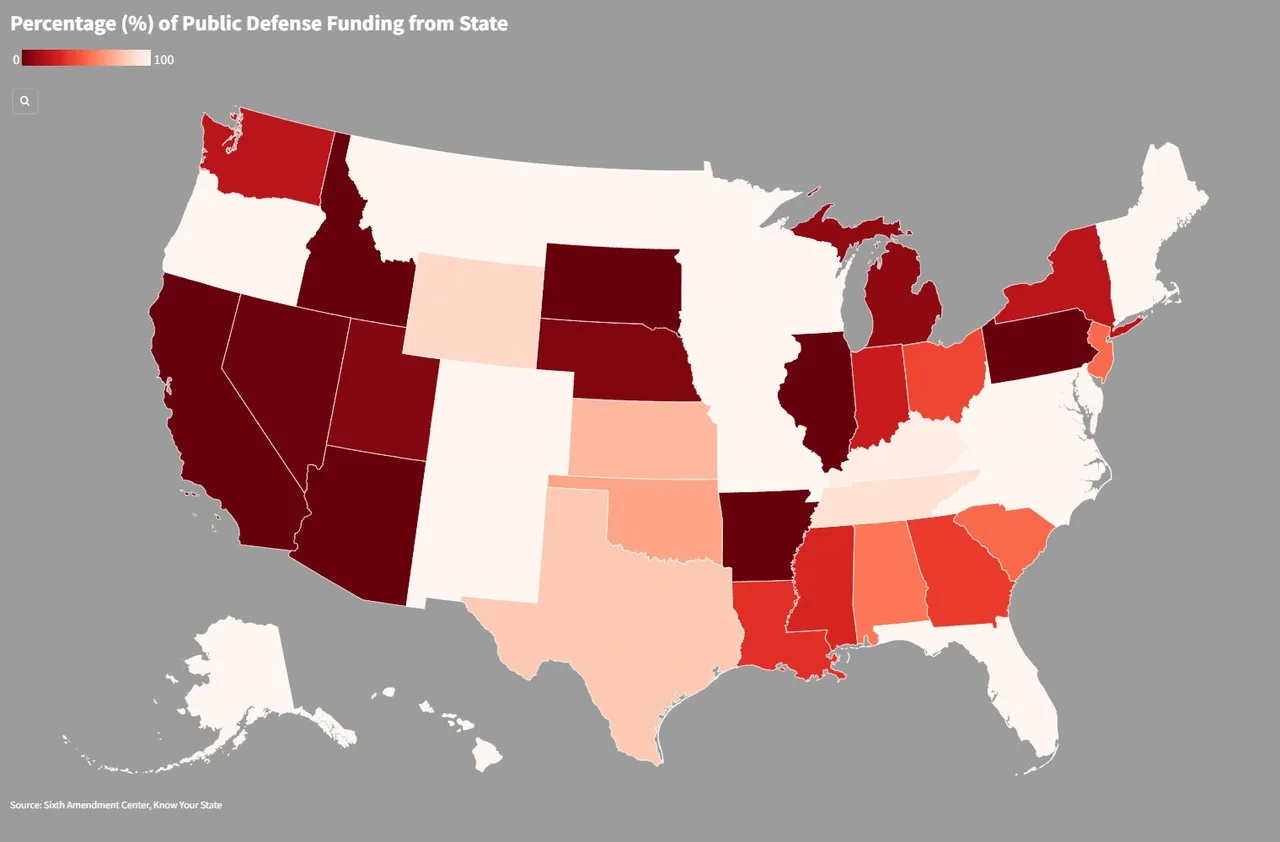
At first glance, there may not appear to be an issue with relying heavily on local funding. But the Sixth Amendment Center put the benefits of a state funding system best: “Local governments have significant revenue-raising restrictions… the jurisdictions that are often most in need of indigent defense services are the ones that are least likely to be able to afford it.” Louisiana is just one of the disastrous examples of what happens when states do not take significant responsibility in funding public defense.
Create Equal Funding Laws
While states should willingly choose to better prioritize their constitutional responsibility to provide an adequately funded public defense function, legislators could require equal funding between public defender offices and district attorney offices. Two examples of jurisdictions and states already doing this are Orleans Parish and the state of Tennessee.
Orleans Parish passed a city ordinance in 2020 that began the process of requiring parity in funds between Orleans Public Defenders and the District Attorney’s Office. The city is beginning to see the fruits of that reform with New Orleans’ 2022 FY Budget providing 85% funding for the public defender’s office. While this is not full parity or an elimination of funding through fines and fees, it is a step in the right direction and a step toward significant and consistent funding albeit not by the state of Louisiana. Similar to Orleans Parish’s ordinance, Tennessee has a state law that requires any local increase in funding for the district attorney’s office to result in a 75% increase for the local public defender’s office. While neither 85% nor 75% is actual parity, it is a marked improvement on the disparity that plagues most states. If every state adopted a similar law to Tennessee, the total public defense funding would increase by $3.27 billion, more than double of what it is today.
Conclusion
National Public Defense Day is a time to appreciate the crucial role public defenders play in our criminal legal system. This appreciation should also highlight the shortcomings we still face in fully providing the right to counsel. Just having the right to counsel is not enough. We must provide adequate counsel in our adversarial system by addressing the chronic underfunding of public defender’s offices across the United States.
[1] “Lawyers in criminal courts are necessities, not luxuries.” Gideon v. Wainwright, 372 U.S. 335 (1963).
[2] If you want coverage of this topic with more wit and better comedic timing, I recommend you watch the episode of John Oliver’s Last Week Tonight which featured this topic.