

By Jason Pye | Due Process Institute | Director, Rule of Law Initiatives
Bipartisan legislation that Due Process Institute supports—the Eliminating a Quantifiably Unjust Application of the Law (EQUAL) Act—S. 79 and H.R. 1693—was introduced this Congress to eliminate the federal sentencing disparity between crack cocaine and powder cocaine offenses. The EQUAL Act does this by repealing the weight thresholds for crack cocaine—see 21 U.S.C. § 841 (b)(1)(A)(iii), 21 U.S.C. § 841 (b)(1)(B)(iii), 21 U.S.C. § 960(b)(1)(C), and 21 U.S.C. § 960(b)(2)(C). With these provisions repealed, crack cocaine offenses would be sentenced the same way as powder cocaine offenses—not less, not more. And, importantly, the EQUAL Act would apply these statutory changes to pending cases, regardless of when the offense was committed. Even more crucially, upon motion of a defendant, the Bureau of Prisons, an attorney for the federal government, or a court, the legislation allows for potential retroactive application to an offense involving crack cocaine based on consideration of a number of common sense factors set forth in 18 U.S.C. § 3553(a).
A newly released impact statement from the U.S. Sentencing Commission shows that the retroactive provision of the EQUAL Act would lead to an estimated 7,644 individuals receiving a reduced prison sentence. The average sentence is predicted to fall from 173 months (approximately 14.5 years) to 100 months (over 8 years). These sentence reductions would reunite families quicker than what current law allows and would also lead to cost savings. Before anyone makes up their mind on the subject of drug sentencing policies like this one, I encourage them to try to understand as much as they can about the history behind our harsh national drug policies.
But Isn’t Crack Worse than “Regular” Cocaine?
First, as the U.S. Sentencing Commission has explained, crack is not a wholly different type of drug but merely a different form of cocaine: “Crack cocaine is made by dissolving powder cocaine in a solution of sodium bicarbonate [baking powder] and water.” There is no evidence to support a scientific conclusion that dissolving powder cocaine in baking powder and water transform the cocaine base into a significantly “worse” drug than the powder cocaine from which it was made. Pharmacologically, crack cocaine and powdered cocaine are the same. So how do crack cocaine and powder cocaine differ? Crack cocaine is cheaper and easier to access, particularly in poorer communities in which the cycle of addiction often goes unbroken generation after generation.
The Sentencing Commission has also looked at the question of comparative addictiveness, finding that how the drug is administered is what makes crack “more potentially addictive” than powder cocaine. In 1995, the Commission explained: “Addiction is more likely when a drug is administered, as is crack, through smoking rather than through nasal insufflation (snorting). However, the Commission determined that this is not a reliable basis for establishing longer penalties for crack cocaine, because powder cocaine may be injected and injection is even more likely to lead to addiction than is smoking.” So even the entity in charge of creating and administering federal sentencing policy believes that the potential that crack is more addictive than powder cocaine has nothing to do with it having an inherently more addictive chemical composition but instead merely relates to how it is typically consumed.
So if Crack Isn’t Worse Than Powder Cocaine, why Did Congress Create a Sentencing Disparity In the First Place?
In October 1986, Congress passed the Anti-Drug Abuse Act, which contained a 100:1 sentencing disparity (essentially meaning that crack cocaine offenses were treated 100 times worse than a powder cocaine offense). The fast-moving legislation was fueled by a few celebrity incidents, such as the overdose of college basketball star Len Bias, who actually died from a powder cocaine overdose that was initially misreported to be a crack overdose, as well as the concerns and fears related to a so-called crack “epidemic” in the 1980s, which coincided with rising violent crime rates and poverty in urban cities.
The fear was real, but these fears weren’t grounded in fact. In fact, several scholars have noted that an increase in use and trafficking of crack cocaine occurred only after significant sensationalized media coverage of the drug as a new “epidemic.” In a 2004 paper, Crack in the Rearview Mirror: Deconstructing Drug War Mythology, Craig Reinarman and Harry G. Levine devote space to the role the media played in the public perception of crack cocaine. Reinarman and Levin write, “[T]he media apparently were not willing to let the absence of evidence get in the way of a good story. Available at the time were anecdotes about people who had used crack and fallen into the abyss of addiction—just the sort of ruin and redemption tales that make for the melodrama media executives believe attracts viewers and readers. So they substituted clinical anecdotes and recovery narratives for epidemiological evidence, routinely invoking the words ‘plague’ and ‘epidemic’ to put the most fearful spin possible on the emergence of a new form of illicit drug use.” The history of this phenomenon has been the subject of numerous research papers and documentaries, including a recent Netflix production, Crack: Cocaine, Corruption, and Conspiracy.
There’s no evidence that there were any other factors involved in Congress’s consideration of the original disparity of 100:1 in the Anti-Drug Abuse Act of 1986. In fact, Eric Sterling, who served as counsel to the House Crime Subcommittee at the time has suggested that the Anti-Drug Abuse Act was hastily rushed through Congress and the disparity was essentially created out of thin air. In written testimony to the U.S. Sentencing Commission in March 1993, Sterling explained, “Regarding the 100:1 cocaine to crack ratio, it was originally a 50:1 ratio in the Crime Subcommittee’s bill, H.R. 5394, and was arbitrarily doubled simply to symbolize redoubled congressional seriousness. Even the 50:1 ratio was too high.”
The legislative history of what became the Anti-Drug Abuse Act begins with then-Speaker Tip O’Neill (D-MA). According to Sterling, “Speaker O’Neill returned from Boston after the July 4th district work period where he had been bombarded with constituent horror and outrage about the crack cocaine overdose death of NCAA basketball star Len Bias after signing with the championship Boston Celtics.”
O’Neill made omnibus legislation to combat the problem a priority for the House Democratic Caucus, which, Sterling said, would “eas[e] the reelection concerns of many Democratic members of the House, by ostensibly preempting the crime and drug issue from the Republicans who had used it very effectively in the 1984 election season.” The goal for O’Neill was for the House Judiciary Committee to finish its work before the August recess.
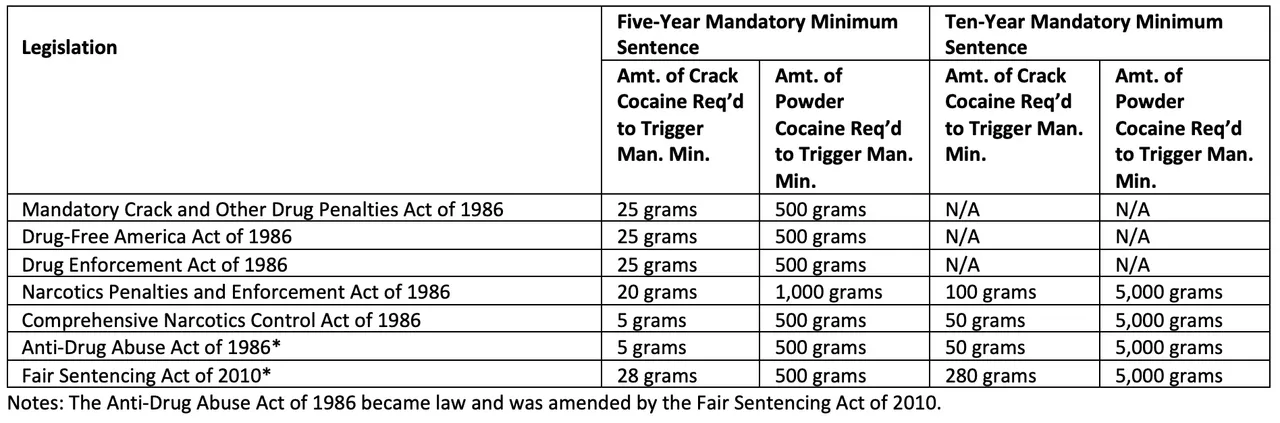
In August 1986, Democrats on the House Judiciary Committee proposed harsh treatment of crack cocaine with the introduction of the Narcotics Penalties and Enforcement Act (H.R. 5394), which had a 50:1 ratio. The Narcotics Penalties and Enforcement Act became the basis for the House Judiciary Committee’s section of the Anti-Drug Abuse Act (H.R. 5484).
Days later, Sens. Alphonse D’Amato (R-NY) and Paula Hawkins (R-FL) proposed the Mandatory Crack and Other Drug Penalties Act, S. 2787, which would have created a 20:1 disparity. Introduced the following month, the Reagan administration’s legislation, the Drug Free America Act (S. 2849) and Senate Republicans’ Drug Enforcement Act (S. 2850) also would have created a 20:1 disparity.
Senate Democrats double-downed on the race to the bottom. Minority Leader Robert Byrd (D-WV) introduced the Comprehensive Narcotics Control Act (S. 2798) on behalf of then-Sen. Joe Biden (D-DE). The Comprehensive Narcotics Control Act first included the 100:1 disparity. This 100:1 disparity would ultimately be included in the Anti-Drug Abuse Act, which was signed into law by President Reagan in October 1986.
The History of Attempts to Reform the Disparity
With almost ten years of sentencing data using the 100:1 disparity, and after deliberate exploration of the issue, the Sentencing Commission proposed equalization of the treatment of crack and powdered cocaine offenses as far back as 1995 and adopted an amendment to the federal Sentencing Guidelines to eliminate the disparity. Congress, however, rejected that Guidelines amendment, thus preventing it from becoming law. (For a brief explanation of how federal sentencing works, see note [1] below.)
Much later, in May 2007, the Commission did successfully amend the drug quantity table in the Guidelines. This amendment lowered the sentencing range for trafficking 5 grams of crack cocaine from 63 – 78 months’ imprisonment to a range of 51 – 63 months and lowered sentences relating to 50 grams or more from 121 – 158 months to a range of 97 -121 months.
In December 2007, the Commission made their most recent Guidelines amendment retroactive. More than 25,500 people applied for resentencing under the Guidelines amendment, 64.4 percent of whom were granted relief. The average sentence after sentence modification ranged from 124 months to 150 months. (Contrary to what some said at the time, this was not the first time that the Commission had applied a Guidelines amendment retroactively.)
In 2010, a bipartisan group of senators led by Sens. Dick Durbin (D-IL) and Jeff Sessions (R-AL) ushered the Fair Sentencing Act through Congress. The Fair Sentencing Act lowered the sentencing disparity between crack and powder cocaine offenses from 100:1 to 18:1 and repealed the five-year mandatory minimum for simple possession. Applying to only current and future crack cocaine offenses, the Fair Sentencing Act was so uncontroversial that it passed both the Senate and the House by voice vote.
The chart below summarizes the legislation over time that has addressed crack cocaine sentencing.
The Commission made the Guidelines amendment related to the Fair Sentencing Act retroactive, although this provided only very limited relief. Nearly 14,000 people filed for retroactive relief under the Fair Sentencing Act. Roughly 7,800 were granted sentence modifications. The average sentence fell from 153 months to 123 months. The Commission also released a report on the recidivism rates of those who benefited from retroactive relief of the Guidelines amendment. Importantly, the report found that the recidivism rate of beneficiaries of the Guidelines amendment was the same—37.9 percent—as those who had completed their full sentence.
Congress further addressed crack cocaine sentencing in the First Step Act of 2018. Section 404 of the First Step Act applied the lower 18:1 ratio (the core reform of the Fair Sentencing Act) retroactively. This provision of the First Step Act, like the other modest sentencing reforms included in the legislation, was taken from Section 105 of the Sentencing Reform and Corrections Act, which itself was borrowed from the Smarter Sentencing Act. Ultimately, more than 3,700 people were granted sentence modifications under Section 404 of the First Step Act. The average sentence fell from 274 (almost 23 years) to 202 months (almost 17 years).
Racially Disparate Outcomes of Punishing Crack Cocaine Offenses More Harshly
The racially disparate outcomes that we’ve seen as a result of the harsher treatment of crack cocaine compared to powder cocaine cannot be ignored. For example, federal sentencing data over a period of more than a decade show a significant disparity in the race of those prosecuted for crack cocaine trafficking offenses.
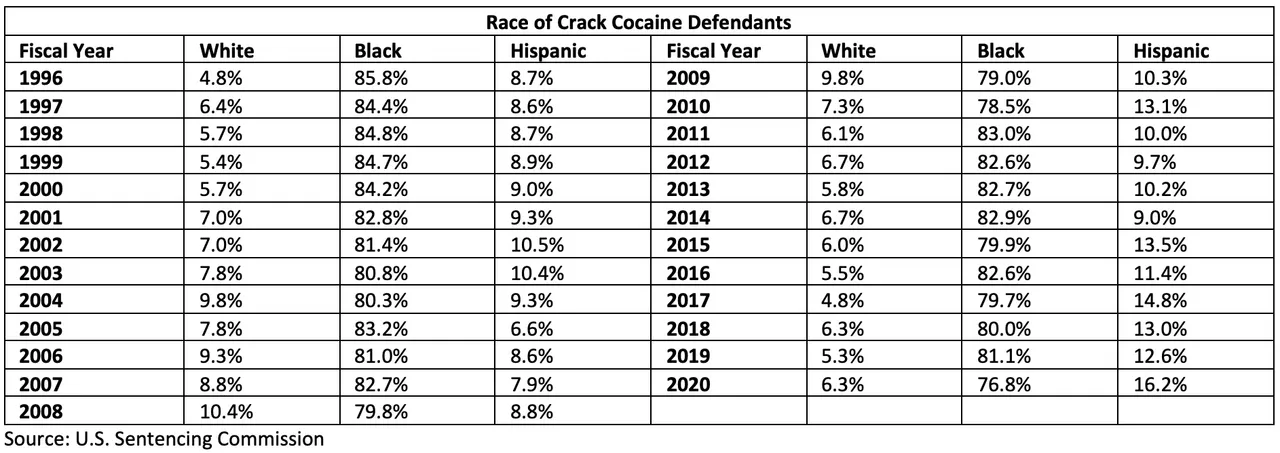
Retroactivity reports from the Sentencing Commission related to Guidelines amendments and the passage of the First Step Act also highlight the racially disparate impact:

Importantly, although federal defendants prosecuted for crack cocaine are overwhelmingly Black, annual data from the Substance Abuse and Mental Health Services’ National Survey on Drug Use and Health show that those who admit to using the substance over their lifetimes are overwhelmingly White.
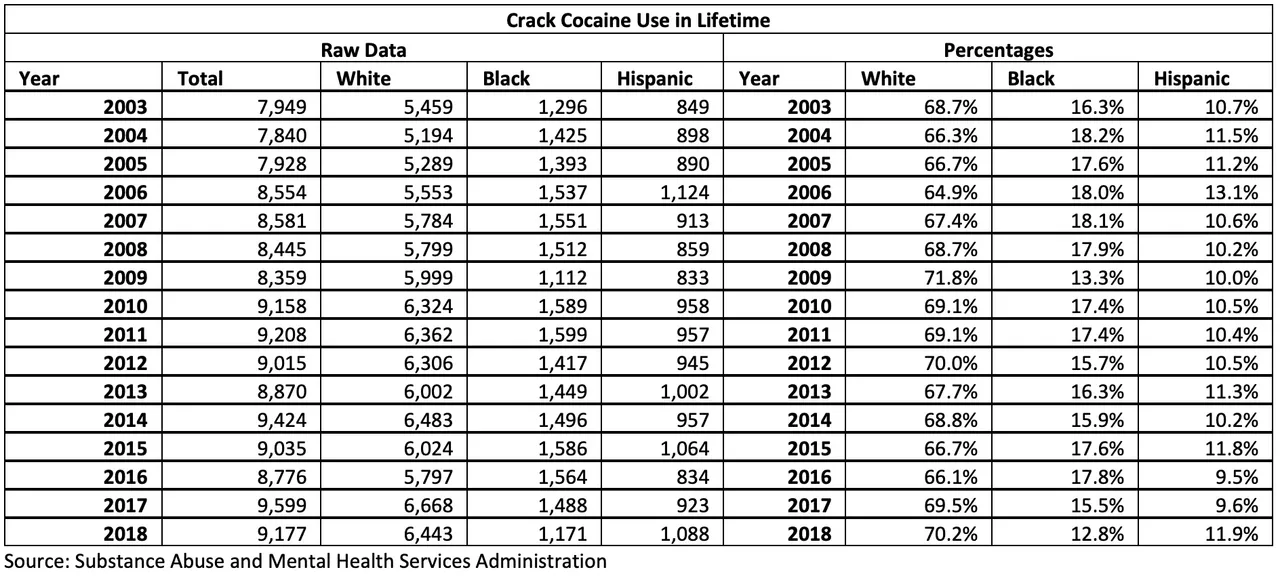
The reasons for the racial disparities between those prosecuted for crack and those who use crack are likely due to policing and prosecution disparities. There is a mountain of evidence demonstrating that people of color are more likely to be searched by police than Whites.
Why Not Equalize the Treatment of Crack Cocaine and Powder Cocaine?
Although the EQUAL Act—which would finally eliminate any difference between the sentencing of crack cocaine versus powder cocaine offenses—has attracted significant bipartisan support, some have raised concerns. The main concerns raised involve a fear that cocaine overdose deaths have increased, a misunderstanding involving the amount of crack that can be produced relative to powder cocaine, and fears concerning higher criminal histories and the presence of firearms in crack cocaine related offenses. But none of these concerns are reasons to not support the EQUAL Act.
First, data from the Centers for Disease Control and Prevention do show that cocaine overdose deaths have increased, but there’s more to the story. The data show that the increase in cocaine overdose deaths is being driven by the presence of synthetic opioids combined with cocaine. Cocaine overdose deaths where synthetic opioids aren’t present have been stable over the past few years. The policy concern of synthetic opioids such as Fentanyl is a separate issue that should be addressed separately from the sentencing disparity between crack cocaine and powder cocaine. Any effort to make Fentanyl abuse a part of this discussion is either seriously misguided confusion or petty politics.
Second, the myth related to relative dose size has been corrected by the Sentencing Commission. In a 2007 report to Congress, when 5 grams of crack cocaine triggered a mandatory five-year penalty, the Commission noted that 1 gram of powder cocaine actually yields far more doses than 1 gram of crack cocaine. As the Commission explains: “With respect to doses, one gram of powder cocaine generally yields five to ten doses, whereas one gram of crack cocaine yields two to ten doses. Thus, 500 grams of powder cocaine—the quantity necessary to trigger the five-year statutory minimum penalty—yields between 2,500 and 5,000 doses. In contrast, five grams of crack cocaine—the quantity necessary to trigger the five-year statutory minimum penalty—yields between ten and 50 doses.” Under the current weights, the current weight of crack cocaine triggering the five-year mandatory minimum—28 grams—would yield 56 to 280 doses. Therefore, even extrapolated out for equalization between crack cocaine and powder cocaine, potentially far fewer doses of crack would be yielded.
As for a concern relating to higher criminal histories and increased firearms involvement in crack cocaine offenses, even when the Sentencing Commission voted in 1995 to eliminate the disparity in the Guidelines, the Commission noted that other factors—such as criminal histories and guns—would still mean lengthier sentences through sentencing enhancements and “upward departures” from the Guidelines. The Commission has also noted that “[a]lmost all crack cocaine related violence is of the ‘systemic’ type, that is, violence that occurs within the drug distribution process.” The answer to these concerns, therefore, is not to oppose the EQUAL Act, but to understand that crack cocaine offenses are not inherently more violent than other drug offenses and that sentencing law already takes into account high criminal histories of a defendant. Moreover, numerous sentencing enhancements already exist to address crimes of violence or gun possession that happen in connection with a crack cocaine (or any other drug) offense. These sentencing enhancements include 18 U.S.C. § 851, 18 U.S.C. § 924(c), and 18 U.S.C. 924(e). Importantly, in any resentencing stemming from the retroactive provision of the EQUAL Act, judges will be required to consider a variety of factors in assessing whether to lower anyone’s sentence, including the nature and circumstances of the original offense, the history and characteristics of the defendant, the seriousness of the offense, deterrence of criminal conduct, and what is necessary to protect the public. An individual’s criminal history and/or the use or possession of firearms would therefore be seriously considered during any potential resentencing.
Conclusion
Given the well-documented arbitrariness and racially disparate impact of cocaine offense federal sentencing, it’s not a matter of if Congress will eliminate the disparity. Rather, it’s a matter of when. The EQUAL Act rights the original sin committed by Congress when it reacte to the rise of violent crime in the 1980s by enacting this irrational disparity and it would continue the bipartisan progress of the sentencing reforms contained in First Step Act. I strongly urge lawmakers on both sides of the aisle to join a rising chorus of support for this long overdue reform.
[1] When Congress creates a criminal law, it will usually set a punishment for that crime that involves a term of imprisonment. Congress will generally set a maximum sentence a person can receive and sometimes will set a mandatory minimum prison sentence. When a federal judge is determining how long to sentence a federal defendant for any offense, he or she will be guided by whatever the Congress included in its law plus whatever appears in the U.S. Federal Sentencing Guidelines Manual. This document—often referred to in shorthand as “the Guidelines“—is created by the U.S. Sentencing Commission, which is an independent federal agency. Congress has the power to order the Sentencing Commission to create or amend the Guidelines, but frequently it is the Commission itself that amends its own Guidelines. However, when it does so, Congress still has the power to reject the Sentencing Commission’s amendment and can prevent it from becoming law.