

By Jason Pye | Due Process Institute | Director, Rule of Law Initiatives
Crime has been among the top issues on the minds of Americans in recent years. Exit polls from the 2022 midterms found that crime was the third most important issue in the election cycle, tied with gun violence, behind abortion and inflation. Unfortunately, since we live in an age of the 24-hour news cycle and opinion shows disguised as news, there’s always a market for “bad news” that incentivizes more coverage, and that includes the topic of crime.
With extraordinarily narrow margins in Congress and an increasingly volatile hyperpartisan atmosphere, the quest for political power has led to misleading narratives about crime. Sadly, those narratives have negatively impacted the ability to move legislation that would improve our criminal legal system and create pathways for second chances to help reduce the rates of repeat offenses and, thus, enhance public safety. This cognitive dissonance is disturbing, even to the most seasoned advocates.
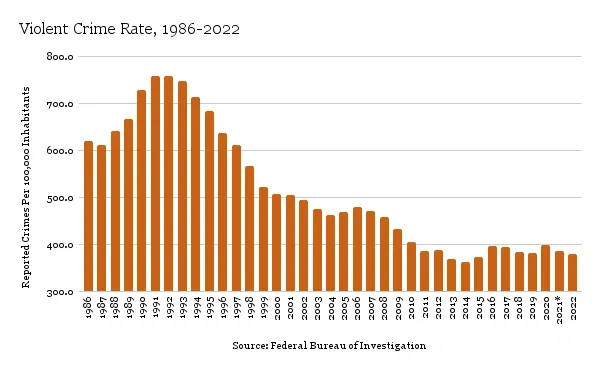
Americans tend to have a view of crime that doesn’t match reality. That’s not to say that violent crime didn’t increase in 2020 and 2021. The data tell us that it did. (Sadly, little attention is given to the causes of the increase, which occurred in the backdrop of a global pandemic.) However, if you listened to the rhetoric from most sources, America is currently experiencing crime at record-high levels. However, in 2022, the National Crime Victimization Survey National Crime Victimization Survey reports violent victimizations within fractions of a percentage point of the violent victimization rate in 2018. And, according to data released by the Federal Bureau of Investigation, in 2022 the violent crime rate decreased to slightly below what the rate was in 2019 (380.7 crimes reported to law enforcement per 100,000 inhabitants). In fact, the rate for 2022 is lower than at any point from 1986 through 2012. This decrease is due to a decline in reported rape and aggravated assault rates. Although the homicide rate also slightly declined, it is still higher than the lowest rate reported in 2014. Importantly, however, it is still much lower than the average homicide rate between 1991 and 2000. The homicide rate in 2022 was the same as it was in 1998. This is all good news [1] that politicians should be sharing with their voters, trying to foster a sense of well-being in an otherwise chaotic world. But they’re not.
Life as we know it is rife with a number of challenges: we’ve seen an increase in political violence, as tensions are heightened in this incredibly frustrating era of hyperpartisanship. Racial tensions continue to be high due to a lack of knowledge and empathy in what occurs during interactions between people of color and law enforcement. Global peace is threatened by terrorism and warfare in multiple parts of the world. Our society continues to struggle with a meaningful response to addiction, poverty, and mass shootings. But those politicians who claim that we’re also experiencing “record high levels of crime,” a “crime wave,” or that we’re living during “lawless times” are exceedingly disingenuous and only trying to score cheap political points for temporary political power. This tactic of scaring voters–regardless of the facts–has unfortunately historically worked. I’m hoping that this time around, the American people won’t fall for it.
[1] There are, unfortunately, certain aspects of the 2022 data that aren’t good news. Although property crime decreased in 2022 compared to 2020–continuing a nearly uninterrupted decline–the larceny-theft rate and the motor vehicle theft rates saw increases.