
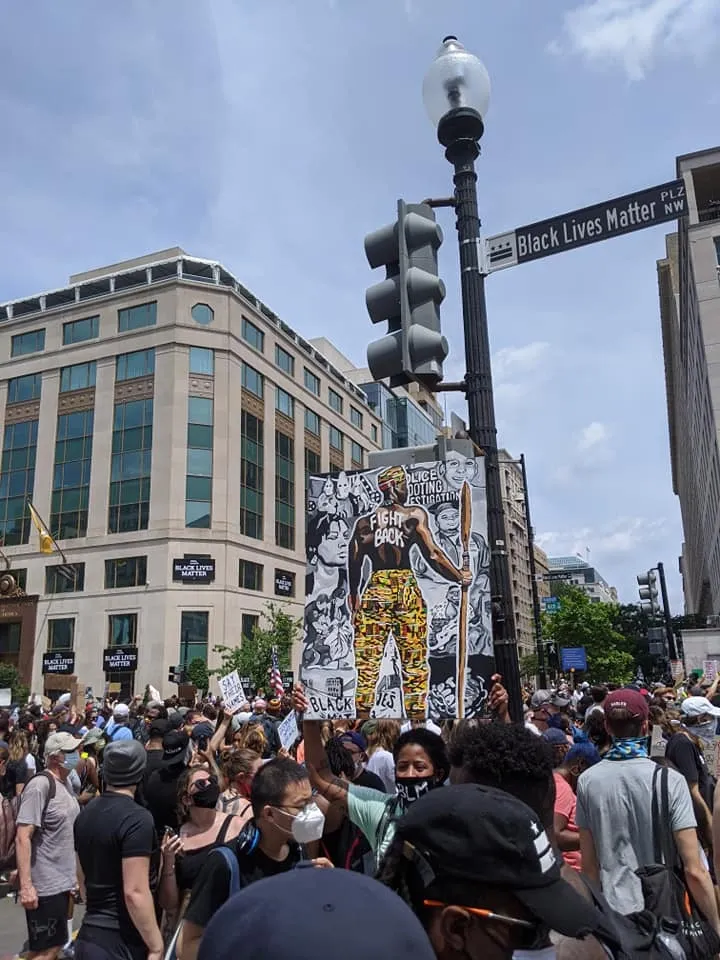
By Billy Easley II | Senior Policy Analyst | Americans for Prosperity. ©Photo by Billy Easley II.
For two weeks in June, at 7 PM, our block in DC comes alive with a cacophony of pots and pans being beaten in protest. At 8 PM, they say the names of black people killed by police. I joined those chants every day the first week but now, I leave home at 6:50 PM to avoid them.
I can’t even put a name to what I’m avoiding. But I feel ungrateful. I’ve wanted this type of passion, this investment in the movement to reform police to become mainstream for years. And here it is! But I’m slinking down to Rock Creek Park or up to 14th Street to not hear it. The added insult is I’m the only black person on the block. If anyone is supposed to be there….
The first few times I joined in the cacerolazo it felt rhythmic despite the noisiness, like a dissonant prayer. But I never led the chant of the names. Those names carry weight. I know some people on and off the Hill who use that weight as fuel, as a reason to redouble their efforts. But I have never been this way. It’s just heavy. Honoring them I can do, but I can’t carry those names on a day-to-day basis. It makes the task of reform seem so daunting, so impossible.
I am not sure that others feel the same weight of these names. New York Governor Andrew Cuomo told protestors that it was time to go home. “You don’t need to protest, you won,” he said, shortly after he signed several policing reforms into law. Conservative commentator Tom Nichols made a similar statement and warned about the impact continuing protests could have on the November election. Their statements show that neither of these men understands the deep-seated frustrations and mistrust driving whole communities to the streets.
After Rayshard Brooks was killed in a Wendy’s drive-thru in Atlanta, the city’s police chief resigned, the mayor fired the officer responsible, and video evidence revealed that Brooks had grabbed an officer’s taser and may have aimed it at officers. But rioters in Atlanta still set that Wendy’s aflame and protesters shut down the interstate. The rot in public trust is so deep that, even when police departments are held accountable and even if political leadership agrees that the use of force was unjustified, the assumption in these communities—even where political and law enforcement leadership looks like them—is that the system cannot be trusted. Despite what Governor Cuomo and Nichols believe, this is not a situation that can be remedied by policy changes, a fired police officer, or an increase in public support for reform. This is a legitimacy crisis. New laws alone will not restore trust in our nation’s criminal justice system.
I am optimistic that America and its institutions can rise to this challenge. Never have I seen so many people across different areas of life so invested in transforming our criminal justice system for the better. Since George Floyd’s death, the increased public support for reforming police practices has been nothing short of astounding. Democratic and Republican leadership, including the White House, now view a policing reform package as a political necessity. We may never see another moment like this, where the political consensus and the public’s interest in reform have so urgently aligned.
But my optimism is dampened by the cost. Why is the price of public attention and political capital in the reform movement always black life and black suffering? There is something deeply perverse that only after Breonna Taylor’s death did the movement to eliminate no-knock warrants gain traction—inspiring cities to ban the practice and members of Congress to introduce legislation to end it. Why did George Floyd and Eric Garner have to die for multiple state legislatures to consider banning chokeholds? The police tactics that took these lives are not new. While black people experience more excessive force than other demographic groups, white people aren’t exempt: the same knee restraint technique that killed George Floyd killed Tony Timpa.
Whatever the reason is, we cannot let these deaths be in vain. After the initial rush of protests fade, the even harder work of determining what comes next begins. I do not agree with the police abolitionists who believe reform only entrenches a racist, broken institution, but they are correct about this one point—the solutions to this crisis will require more imagination than legal reforms or funding increases to police departments. Ending qualified immunity, banning no-knock warrants, and demilitarizing the police are all worthwhile reforms that will take significant political capital to obtain. These policy reforms will not reduce the number of interactions police have with citizens or change the culture of the more than 15,000 police departments in this country. For example, Joe Biden has advocated for a national ban on chokeholds in response to George Floyd’s death, but the NYPD’s ban on chokeholds did not stop officers from using it against Eric Garner. New rules and regulations are insufficient to rebuild our police departments in a way that results in real change.
Nor can we rely on the Department of Justice or federal grantmaking to implement significant change. Senator Amy Klobuchar wants the DOJ to investigate unconstitutional patterns and practices within the Minneapolis Police Department. But the DOJ’s dedication to such investigations shifts from administration to administration and there is no way the DOJ can scale investigations to a substantial number of law enforcement agencies. As we’ve seen in places like Baltimore and New Orleans—both of which were under consent decrees following DOJ investigations—federal intervention does not guarantee a cultural shift in policing practices. There is a role for federal input, but as scholars and criminologists like Tracey Meares, David Kennedy, and Thomas Abt have discussed, community involvement is the key determinant as to whether local law enforcement is seen as responsive and legitimate. It will take the time and dedication of local community leaders working with their police departments to succeed. And it will require experimentation with a variety of different policies and approaches across different departments around the nation, alongside criminologists, to create evidence-based practices that can be used elsewhere.
Police departments should also learn from their failures. For instance, stop-and-frisk in New York City led to increased and unnecessary police interactions with citizens that harmed public trust and led to police violence. Police departments can experiment with decreasing police contact in situations where their presence doesn’t enhance public safety. Recent research suggests that minor traffic stops are not nearly as dangerous for cops as the public or police perceive. Maybe police departments should try Alex Tabarok’s idea of having a different agency handle traffic infractions? Many advocates of abolition, like Jon Ben-Menachem, believe that community reinvestment and expanded social programs are far more effective at reducing crime and police violence than reforming the criminal justice system. Why shouldn’t large, progressive police departments experiment with shifting some of their funding to other areas and see if it reduces crime? Why not simplify, standardize, and encourage data sharing across law enforcement agencies so we can see how different policies are having an impact?
America has been through this cycle before—national revulsion at an unjustified death at the hands of the state, followed by protests, and bookended by government reports and muffled reforms. This time must be different—the consequences of failure demand it. If we fail, the damage to the legitimacy of law enforcement will be so deep it may take a generation to recover. We know what happens when mistrust defines the relationship between the police and the people they serve; look at the crime rates in Baltimore since the Freddy Gray riots or in Chicago for the last few decades. Policymakers can prevent this collapse in legitimacy by cutting off the federal spigot of funds that militarize police departments and ending qualified immunity. The public can prevent it by partnering with local law enforcement and creating use-of-force guidelines, policing practices, and accountability measures that both sides trust. The police can prevent it by listening to the voices of the unheard in the communities they serve, changing the warrior mindset instilled in their forces, and experimenting with new tactics focused away from the use of force. This work will take years, not months. And it will be hard. But if we fail, then this painful moment in our history will have been for nothing.
Billy Easley II is a conservative policy analyst dedicated to eliminating racism in the criminal justice system and in emerging technology. He spends his spare time convincing his husband to move back to Texas.