
By Nicole Banister | Due Process Institute | Policy Counsel
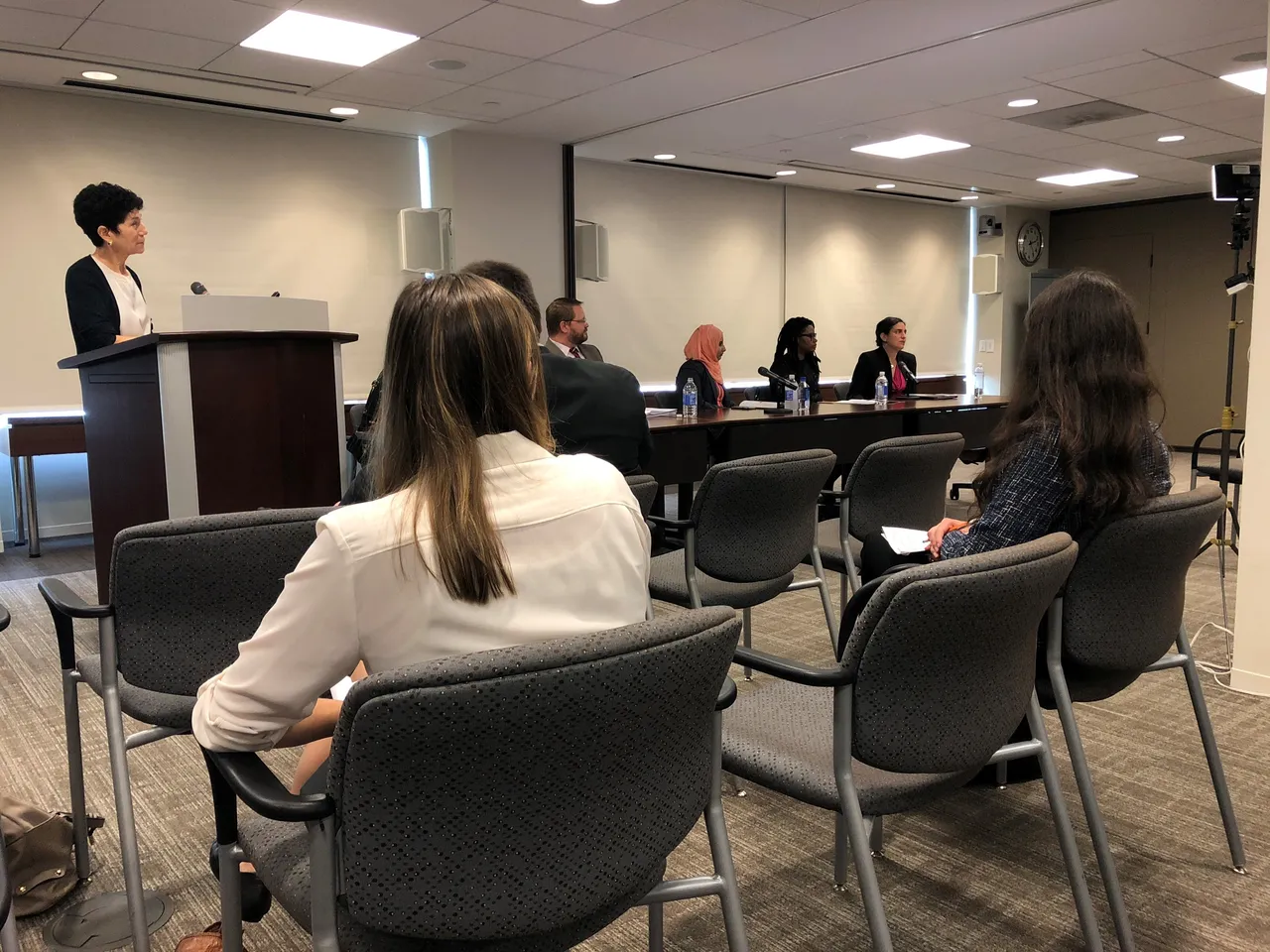
On Wednesday October 10th, the Juvenile Law Center released its new report “The Price of Justice: The High Cost of ‘Free’ Counsel for Youth in the Juvenile Justice System” revealing the laws and policies throughout the United States that require youth and families to pay for court-appointed counsel and the financial burden that follows. The panel event included two authors of the report, Jessica Feierman and Nadia Mozaffar of the Juvenile Law Center, Erin Logan of the Baltimore Sun, Tim Curry of the National Juvenile Defender Center, and Clarise McCants of Color of Change.
Despite the ruling in In Re Gault holding that children in delinquency prosecution have many of the same legal rights as adults in criminal court–including the right to an attorney–the provision of counsel for juvenile defendants continues to face obstacles. In almost every state, children and their parents may be required to pay fees to obtain court-appointed counsel.
Surprisingly, even after a determination of indigency is made, children can be assessed various fees for the use of a public defender. These fees vary from state to state and county to county in the form of application fees, processing fees, public defender fees, or reimbursement. As one defense attorney interviewed for the report aptly noted “[t]he Public Defender’s Office represents indigent children who have indigent parents. Somehow, once they come to court we make believe that they have money.”
During his presentation, Mr. Curry presented one grim example from the state of Arizona. There children charged with crimes are informed of the costs associated with asserting their right to counsel prior to deciding whether to invoke or waive their right. The costs include $25 to ask for court-appointed counsel, $25 for a lawyer to be appointed, and $300 to $400 for the representation. These are cases where the juvenile has already been determined to be indigent. Understandably, Mr. Curry notes, most children look at their parents after hearing the list of costs and decide to waive their right to counsel. The pressure that fees place on children to waive counsel compound throughout the process as children without representation are even more likely to accept a plea bargain. Such plea deals may come with probation or other court services that ultimately saddle the kids and their parents with an even larger bill than that of the “free” lawyer.
The practice of sending a bill to the parents of incarcerated children is long-standing in the United States. This is based in part on the idea that parents are responsible for their justice-involved children and the state should not bear the child support costs, as well as a belief that such fees are necessary to operate juvenile detention centers. Ultimately, however, parents are not volunteering to send their children through the juvenile system nor are they viewing that time as child support or care to be reimbursed.
Thankfully, there is some movement towards ending this burdensome practice. In 2017, California passed SB 190 eliminating all fees for defense counsel as well as other court costs for juveniles. Unfortunately, those reforms did not come soon enough for Maria Rivera, whose son was held in a juvenile detention center in Orange County for more than a year. She received a bill totaling $16,372, $23.90 for each day her son was detained and $2,199 for legal expenses, including public defender costs. She made one payment of $9,508, after selling her home, but was unable to pay the remainder of the bill. She ultimately filed for Chapter 7 bankruptcy. Orange County argued that the debt she owed for her son’s juvenile detention should be classified as a “domestic support obligation” and therefore exempt from discharge. Thankfully, The Ninth Circuit Court of Appeals ultimately reversed the Bankruptcy Court decision, determining that “[t]he ‘support’ that the Probation Department provided to Rivera’s son in the course of his detention was incidental to – and the price of – its larger governmental purpose of promoting ‘public safety’ and ‘reducing crime’ through ‘corrections practices.’”
The reforms in California passed after an examination into the precise funding structure of the public defender and juvenile justice systems in California counties. The Juvenile Law Center Report explains that in most counties, the counsel fees were not being used to fund the public defender and in many places the cost of collecting on the fees outweighed any amount recovered. Thus, charging children and parents for use of a public defender not only undermined the fairness of the criminal process but also resulted in little to no financial gain to the county.
Counsel costs also risk extending a young person’s involvement in the juvenile justice system. When an inability to pay court costs results in a violation of probation, children are thrust back into the court process with further hearings only adding to their bill.
Overall, there is very little benefit to the justice system in charging youth and families a fee for court-appointed counsel; however, the impact of these fees on the lives of children and their parents is severe. Insurmountable debt, violations of probation, damaged credit, and inability to expunge their record are all real consequences in a justice system that charges kids for their “free” lawyer. These policies set youth up to fail.
This new report, and the work of the Juvenile Law Center in this area, should encourage more jurisdictions to end the practice of charging children for their public defenders and to create more fair and equitable juvenile justice systems.