
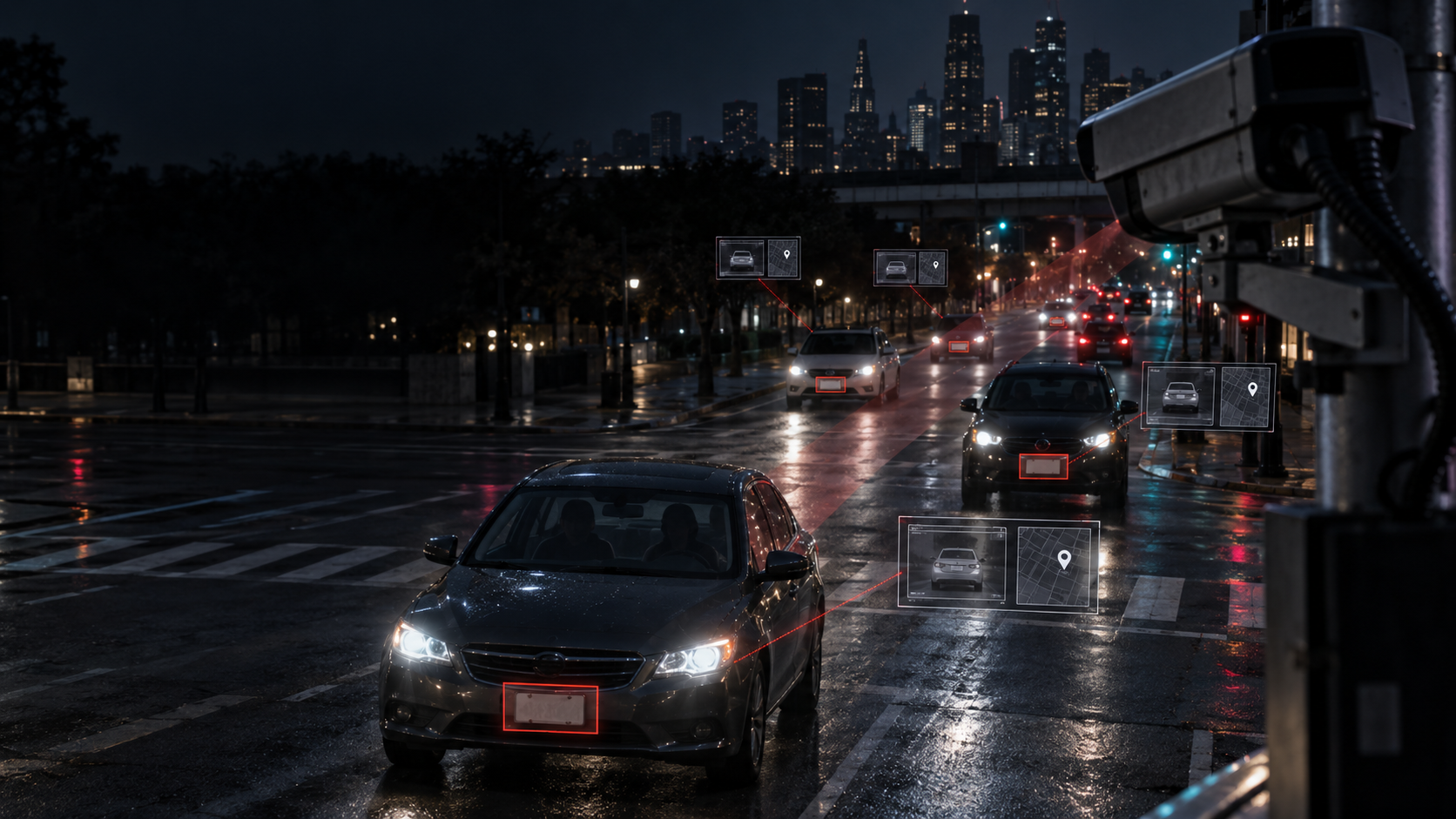
The surveillance network hiding in plain sight
By Jason Pye | Due Process Institute | Vice President
In this era of rabid hyper-partisanship and mind-numbing political tribalism, there are a handful of hot-button issues that bring progressives, conservatives, and libertarians together. One of those issues is the use of automated license plate readers (ALPRs) from companies like Flock.
ALPRs are cameras paired with software that reads license plates and converts the images into searchable data. The cameras can be fixed to streetlights, overpasses, traffic signals, trailers, and neighborhood entrances, or mounted on police cruisers. When a vehicle passes, the system generally records the plate number, a photograph of the vehicle, and the date, time, and location of the scan. Depending on the camera’s angle and capabilities, that photograph may also capture the driver or passengers inside the vehicle. Newer systems can identify a vehicle’s make, model, color, damage, roof racks, bumper stickers, and other distinguishing characteristics. In other words, these systems may collect considerably more than the string of letters and numbers printed on a license plate.
A police department puts cameras at major intersections or roads leading into town. Plates are checked against a “hot list,” and officers receive an alert when the system believes it has found a match. Investigators can also search historical data after a crime to identify vehicles that passed through a particular area or look for a vehicle’s movements over time. Municipalities use related systems for toll collection, parking enforcement, and access control, while homeowners associations and private businesses install cameras around neighborhoods and commercial property. Some local governments own their equipment and store the data themselves. Others subscribe to a private vendor that supplies the cameras, hosts the data, and connects the department to a much larger network.
A camera purchased by one small police department is no longer necessarily a local tool. If the department participates in a vendor’s sharing network, an officer may be able to search scans collected by agencies or private cameras far beyond the officer’s jurisdiction. An apparently modest local purchase can become one node in a nationwide system for tracking where Americans travel, whom they visit, and which parts of their lives they would prefer to keep to themselves.
A Surveillance System Built From Innocent People’s Movements
Supporters describe ALPRs as tools that look for stolen cars and dangerous people. That description omits the defining feature of the technology: ALPRs do not begin with a suspect and then track that person. They photograph and record everyone who drives past, almost all of whom are not suspected of any crime, so the government can later search their movements.
One scan may seem trivial. Millions or billions of scans, stored and made searchable, are something else. A plate number linked to a place and time can show that a vehicle was near a church, mosque, union hall, gun show, political demonstration, addiction treatment center, abortion clinic, criminal defense lawyer’s office, or the home of a romantic partner. Repeated scans can expose routines: where someone sleeps, where they work, where their children go to school, what they politically support, whether they are religiously affiliated, and which people they see regularly. As the Electronic Frontier Foundation explains in its overview of ALPR technology, aggregated scans can reconstruct historical travel patterns and may even predict future movements.
The usual response is that no one has a reasonable expectation of privacy in a license plate displayed on a public road. There’s some legal force behind the narrow version of that argument. Courts generally haven’t treated an officer’s observation of a single plate in public as a Fourth Amendment search, and the Supreme Court hasn’t held that every ALPR scan requires a warrant. In March 2026, the U.S. Court of Appeals for the Fifth Circuit held in United States v. Porter that the ALPR query at issue didn’t reveal the comprehensive and intimate record of movement that concerned the Supreme Court in Carpenter v. United States.
The narrow legal claim, however, doesn’t answer the policy question. An officer seeing one plate while standing on a street corner just isn’t comparable to thousands of cameras recording millions of vehicles around the clock and placing the results in a database that can be searched months later from another state. The Supreme Court’s holding in Carpenter is important precisely because it rejected the idea that people surrender every claim to privacy merely because individual pieces of location information may be observable or held by someone else. The constitutional line for ALPR databases remains unsettled and may depend on the density of cameras, the retention period of the images, the scope of a search, and the comprehensiveness of the resulting record.
But legislatures don’t need to wait for the Supreme Court to decide how much warrantless surveillance is too much, and misuse isn’t a hypothetical concern. For example, Denise Green was pulled from her car at gunpoint in San Francisco after an ALPR misread one character of her plate and officers failed to notice that the wanted vehicle was a gray GMC truck while Green was driving a burgundy Lexus. More recently, public records and internal investigations have repeatedly shown that officers use plate reader databases to monitor former partners or others for personal reasons. These incidents, of course, aren’t proof that every officer will abuse the system. But they are proof that audit logs, written policies, and promises of professional discipline don’t make abuse impossible. A database designed to reveal a person’s movements will inevitably attract people who want to misuse that power.
The technology also changes the relationship between local police and the public. Before a city builds a network of cameras, the government generally needs a reason to investigate a person and must devote officers and time to the job. ALPRs reverse that sequence. The government first collects records on everyone and waits to decide who might become interesting later. That is not ordinary observation made more efficient. It is suspicionless location surveillance made cheap enough to use everywhere.
The Claims Do Not Survive Serious Scrutiny
ALPR supporters usually begin with real cases. A camera alerted officers to a stolen vehicle. A missing child was located. A murder suspect was identified. Those are important outcomes, and it would be dishonest to claim that ALPRs have never helped solve a crime. The question isn’t whether the technology has ever been useful. The question is whether its overall benefits justify building a searchable record of the movements of millions of innocent people.
Vendors tend to answer a narrower evidentiary record with enormous numbers. Flock Safety has claimed that its technology helps solve hundreds of thousands of crimes and has more recently said it supported more than 1 million investigations and incidents in 2025. Those claims aren’t the same as an independent finding that ALPRs solved 1 million crimes. “Supported,” “assisted,” “involved,” and “solved” are not interchangeable. A plate reader hit may be one lead among many in an investigation that police would have solved without it. Vendor surveys can also rely on participating agencies’ estimates and extrapolate those responses across a much larger customer base. That may be useful marketing research, but it doesn’t establish how many additional crimes were solved because of the cameras.
The independent evidence is much more modest. A 2025 study of a large ALPR expansion found no reduction in violent crime, although it did find associations with reductions in shootings, motor vehicle theft, and property crime. That’s a reason to keep studying specific uses of the technology. It’s not, however, a reason to make sweeping claims that a camera network is responsible for broad declines in crime. Crime rises and falls for many reasons, and communities without enormous ALPR networks have also experienced sharp declines. A vendor can’t simply point to a decline in crime after cameras were installed and claim the cameras caused it.
Supporters also say ALPRs are no different from an officer writing down plates by hand. The comparison collapses under its own weight. A human officer cannot record every car that passes thousands of locations, preserve the information in a searchable national database, and reconstruct a vehicle’s past movements in seconds. The scale, speed, retention, and connectivity are the point of the technology. If ALPRs truly did no more than an officer with a notepad, governments would not be spending millions of dollars to install them.
Another response is that the data are kept for only a short period, often 30 days. Thirty days isn’t a meaningful safeguard when a network captures billions of observations and allows retrospective searches across thousands of cameras. A month of a person’s movements can disclose a great deal. Data associated with an investigation may also be exported, copied into a case file, or retained under an exception. The public is then asked to trust every participating agency, every authorized user, every contractor, and every future administration not to broaden access or change the rules.
The claim that “only criminals need to worry” is even weaker. The system works only because it records innocent people. It can’t identify a wanted vehicle among ordinary traffic without first scanning it. Nor does a hot-list alert establish guilt. Lists can be stale, officers can enter a plate incorrectly, software can misread a character, and a vehicle may be driven by someone other than its registered owner. Even when the initial alert is accurate, the technology supplies an investigative lead, not probable cause in a box. Green’s experience shows what can happen when officers forget the difference.
Finally, supporters point to access controls, audit logs, and local ownership. Those protections are better than nothing, but they don’t cure the basic problem. An audit log often documents abuse only after someone has already been tracked. “Local ownership” may mean little when a vendor operates the platform and sharing settings expose local data to outside agencies. In 2025, an Illinois secretary of state audit found that Flock lacked adequate safeguards and had been running a pilot program that gave U.S. Customs and Border Protection access to Illinois plate data. Flock paused its federal pilots nationwide after the discovery. The episode is an answer to assurances that local officials always know and control who can reach their data.
The same is true of interstate access. A Texas sheriff’s office used a nationwide Flock search in an investigation involving a woman who had self-managed an abortion. Documents later reported by the Electronic Frontier Foundation showed that the matter was an abortion investigation, notwithstanding public descriptions of it as a missing person search. The search reached cameras in jurisdictions where abortion was legal and where officials had attempted to prevent their resources from being used for precisely that purpose. A restriction written into state law is not much protection if a platform’s architecture allows an outside officer to bypass it.
When the Federal Government Comes Knocking
The federal government doesn’t need to build every camera itself to benefit from a national ALPR network. It can seek access through cooperative agreements, task forces, informal requests, direct vendor arrangements, or legal process served on agencies and companies that hold the data. Once federal agents can query a sufficiently broad network, a tool purchased by local governments to combat car theft can be repurposed for immigration enforcement, drug investigations, locating fugitives, identifying people near protests, or mapping the movements and associations of people who were never suspected of anything when their vehicles were photographed.
The Illinois audit offered a glimpse of that future. CBP obtained access through a Flock pilot even though Illinois law restricts the use of ALPR information for immigration enforcement and certain out-of-state investigations. A separate Illinois audit found that the Forest Park Police Department had shared plate reader data with CBP through a Motorola system. These were not conspiracy theories. Federal access existed, and state officials learned about it after the fact.
There’s no reason to assume the federal appetite for location data will remain limited. A 2020 presidential law enforcement commission recommended that the federal government create a national clearinghouse for ALPR data. Thankfully, the proposal wasn’t enacted, but it reveals the inherent institutional pressure these systems create. If thousands of state, local, and private cameras produce searchable records, federal agencies will want to use them. What begins as a patchwork need not be formally centralized to function like a national database.
The federal government’s dealings with commercial data brokers make the risk harder to dismiss. Federal agencies have purchased access to location information generated by mobile applications and compiled by private companies, seeking commercially available data that might otherwise require a more demanding legal process if collected directly. Venntel, for example, sold location data products to CBP and Immigration and Customs Enforcement. In 2024, the Federal Trade Commission brought an action against Venntel and its parent, Gravy Analytics, alleging that they had unlawfully sold sensitive location data capable of revealing visits to medical facilities, houses of worship, labor union offices, and other sensitive places.
ALPR data aren’t identical to cellphone location data, and the legal rules governing them aren’t necessarily the same. The data broker history nevertheless exposes the loophole. When the government faces legal or practical constraints on collecting information itself, it may purchase or obtain access to information that the private sector has already amassed. That’s why restrictions must cover both privately captured plate data and cameras operated under a government contract. A law that limits what police may collect but leaves them free to buy the same information from a vendor has accomplished very little.
Congress should close that end run. The House passed the Fourth Amendment Is Not For Sale Act in 2024, which would have generally required federal law enforcement and intelligence agencies to obtain a court order before purchasing certain information about Americans from data brokers, but the measure did not become law. Any renewed federal legislation should clearly reach location information derived from ALPR networks. Congress should also bar federal funding from subsidizing open-ended plate surveillance, require warrants for searches of historical ALPR data, impose strict minimization and deletion rules, and prohibit federal agencies from using local or commercial systems to evade protections they would face if they collected the information themselves.
States Are Beginning to Push Back
States have taken widely different approaches. According to the National Conference of State Legislatures’ survey of ALPR statutes, state laws may address retention, disclosure, permissible uses, security, or reporting, but the protections vary substantially. California limits the Highway Patrol’s retention of ALPR data to 60 days in most circumstances. Illinois adopted targeted restrictions meant to prevent plate data from being used against people seeking reproductive care or for certain immigration enforcement. Virginia now generally requires system data to be destroyed after 21 days. Connecticut’s 2026 law also uses a 21-day default and restricts ALPR use involving immigration enforcement, reproductive or gender-affirming care, protected First Amendment activity, and other sensitive purposes.
Those are meaningful responses, but New York lawmakers have introduced the strongest comprehensive proposal now pending in a state legislature. Senate Bill 9890, sponsored by state Sen. Michelle Hinchey, prohibits a government entity from operating or using an ALPR system or captured plate data unless the use falls within a specifically authorized category. The bill permits defined uses involving felony warrants, missing persons, stolen vehicles, vehicles currently being used in a felony, registration and insurance enforcement, parking, secured areas, toll collection, and enforcement of vehicle and traffic laws. That structure is stronger than a law that broadly authorizes law enforcement use and then adds a handful of exceptions.
S. 9890 would generally require plate data to be deleted within 48 hours, subject to limited circumstances in which the data are needed as evidence, for adjudication of an enforcement matter, at the request of defense counsel, or under valid judicial process. Forty-eight hours is dramatically shorter than the 21-, 30-, or 60-day periods found in other states and gives police enough time to respond to an immediate hot-list match without allowing every routine scan to mature into a months-long travel history.
The bill also confronts network sharing and the data broker loophole. New York government entities are generally prohibited from selling, sharing, leasing, transferring, or providing access to captured plate data outside the New York government. Federal access would require a federal judicial probable-cause warrant or another valid federal judicial order. An out-of-state warrant would have to involve one of the bill’s specified investigations and conduct that amounts to a felony under New York law. Most importantly, a government entity could purchase, receive, obtain, or use privately captured plate data only with a warrant based on probable cause.
S. 9890 comes with enforcement. Agencies would have to publish annual reports identifying camera locations, the volume of scans, the hot lists used, apparent matches, false matches, arrests or prosecutions following matches, extended retention, and relevant policies. They would have to preserve query and access records for three years. Plate data obtained or used in violation of the law generally could not be introduced by the government in a New York proceeding, although a criminal defendant could introduce otherwise admissible evidence. A person injured by a violation could sue for actual damages or $1,000 in liquidated damages, along with reasonable attorney’s fees and litigation costs, and the attorney general could seek declaratory and injunctive relief.
That combination is what makes the New York bill stand out. It doesn’t rely on a vendor’s assurances or an agency policing itself. It limits purposes, sharply reduces retention, controls interstate and federal sharing, closes the private data loophole, requires public reporting, suppresses unlawfully obtained evidence, and allows injured people to go to court. S.9890 is not a ban, and some of its authorized uses—particularly its broad allowance for enforcing vehicle and traffic laws—deserve continued scrutiny. Still, it treats ALPR surveillance as an extraordinary government power that requires enforceable limits rather than as an ordinary police purchase that the public should simply accept.
The Government Should Not Record Everyone Just in Case
The debate over ALPRs is not a choice between caring about public safety and caring about privacy. Police can investigate stolen vehicles, find missing people, and pursue violent offenders without maintaining a searchable record of every driver’s whereabouts. The hardest cases may justify targeted access based on probable cause. They do not justify building the infrastructure for pervasive mass surveillance and hoping it will always be used responsibly.
Americans should not have to explain why they drove to a protest, a gun show, a church, an abortion clinic, a union meeting, a psychiatrist’s office, or a friend’s home. The freedom to move without the government quietly compiling an itinerary is part of the privacy and autonomy that allow a free society to function. That freedom becomes less real when the government can reconstruct a person’s movements with a few keystrokes.
ALPR systems are often sold one camera at a time, with a separate contract. Their danger emerges when those pieces are connected. A local crime-fighting tool becomes a regional database, the regional databases become a national network, and the national network becomes available to officials with missions the town council never discussed. By the time abuse is discovered in an audit log, the surveillance has already happened.
Lawmakers should act before that network becomes too embedded to unwind. At the federal level, Congress should require warrants, close the data broker loophole, restrict funding, and prevent federal agencies from turning state and local cameras into a national tracking system. At the state level, legislatures should follow New York’s lead by sharply limiting use and retention, blocking indiscriminate sharing, and imposing real consequences for violations. The government should investigate people when it has a lawful reason to investigate them. It should not record everyone’s movements in case a reason appears later.