

Don’t be fooled by those who wrongly take credit for falling crime rates.
By Jason Pye | Due Process Institute | Vice President
The crime data for 2025 likely won’t be released by the Federal Bureau of Investigation (FBI) until August or September, but available indicators suggest the United States may see a potentially historic decline in homicides. Although any decline in crime is certainly good news, it’s important to view these trends in context. The first is historical. The second is in light of recent trends. Both help guide lawmakers and policy analysts in evaluating crime through the lens of empirical evidence rather than reactive politics or hyperbole.
In September, Due Process Institute noted that 2024 saw the lowest violent crime rate since 1969. Violent crime had peaked in 1991 at 758.2 reported crimes per 100,000 inhabitants, but began to rapidly decrease in the 1990s and into the 2000s. The pace of the decline slowed in the mid-2000s, then picked up again in 2006. Prior to 2024, the lowest violent crime rate since 1991 was reported in 2014, at 372.4 reported crimes per 100,000 inhabitants. Even in the midst of the spike in violent crime in 2020, the violent crime rate—392.3 reported crimes per 100,000 inhabitants—was low when put in a historical context. In 2024, the violent crime rate was 359.1 reported crimes per 100,000 inhabitants, or roughly 53 percent lower than the peak in 1991. This made 2024 the new low point for violent crime since 1991.
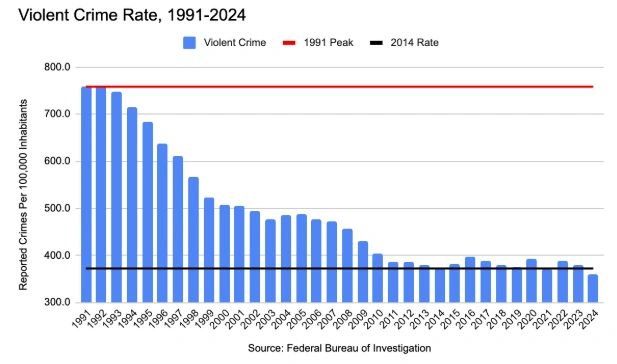
We have to be mindful that the decline in crime in 2024 and the continued decline in 2025 are not the advent of something new, but a return to the norm. The spike in violent crime that began in 2020 was unusual. Violent crime had been trending downward for nearly three decades before the COVID-19 pandemic disrupted personal, social, economic, and institutional life across the country. Courts slowed or shut down. Schools closed. Hospitals filled beyond capacity. Police departments experienced staffing disruptions and changes in policing practices. Individuals faced economic uncertainty, mobility restrictions, and unprecedented social isolation. Persons in need of substantial mental health support and addiction services weren’t prioritized. None of these factors alone explains the increase in violence that occurred during that period, but taken together, they created conditions that criminologists widely viewed as conducive to higher rates of violent crime.
Just as the increase happened quickly, the decline has also been relatively swift. As pandemic-era disruptions faded into memory, many of the conditions associated with the spike in violence began to normalize. Courts resumed more regular operations, mobility patterns returned closer to pre-pandemic levels, and social institutions—from schools to workplaces—reopened. In this sense, the decline in violent crime observed in 2023 and 2024, and the likely continuation of that trend in 2025, appears less like a sudden policy breakthrough and more like a reversion toward the long-running trajectory that preceded the pandemic.
This context matters for lawmakers. When crime rises quickly, there’s often political pressure for sweeping legislative responses. When crime falls quickly, there is an equally strong temptation to attribute the improvement to the most recent policy or political narrative. Both impulses risk misunderstanding the underlying dynamics of crime trends. The long-term decline in violent crime that began in the early 1990s cannot be explained by any single policy change, and the pandemic-era spike and subsequent decline cannot be attributed to any single policy either.
Understanding crime trends requires patience and perspective. The data suggest that the United States is continuing the broader downward trajectory in violent crime that has defined the past three decades, interrupted briefly—but dramatically—by the extraordinary disruption of the pandemic period.
It’s likely that some policymakers will attempt to attribute the recent decline in violent crime to immigration enforcement policies. The Trump administration has already suggested that stricter enforcement and deportation policies have improved public safety. That argument may be politically convenient, but it is not supported by the broader evidence. Violent crime trends in the United States have historically moved largely independently of immigration levels. The broader decline in violent crime began in 1991, and the recent decline, which began in 2022 and accelerated in 2023 and 2024, occurred well before the current administration’s enforcement initiatives could plausibly have had a measurable nationwide effect.
There’s also a large body of research indicating that immigrants—both documented and undocumented—are less likely to commit crimes than native-born Americans. While immigration policy is often debated through the lens of public safety, the empirical literature does not support the claim that immigration levels are a primary driver of violent crime trends.
The lesson should be straightforward. Crime trends are shaped by a complex mix of social, economic, and institutional forces. Attempts to attribute large national shifts in crime rates to a single policy—whether immigration enforcement, policing reforms, or sentencing laws—should be treated with caution. The good news is that violent crime is continuing to trend downward. Just don’t be fooled by anyone claiming it happened for any single reason. The data just doesn’t support such a nice and tidy political explanation.