
Menu
Close
How is it that a jury can find a person accused of a crime “not guilty” but that same defendant can be sentenced for that crime anyway?
This is the problem of acquitted conduct sentencing–an unconstitutional practice Due Process Institute is working to abolish.
In 40 states, as well as under federal law, a jury can find you not guilty of a criminal charge but a judge can still sentence you to jail for many years based on the facts underlying the acquitted charge. This is known as acquitted conduct sentencing, and Due Process Institute is leading the movement to end the practice.
Pictured right: As part of the effort, DPI’s former policy director Joe Luppino-Esposito delivered a presentation on the constitutional flaws with acquitted conduct sentencing to the Criminal Justice Task Force at the American Legislative Exchange Council States and Nation Policy Summit.
“Acquitted conduct sentencing” is a practice that allows federal judges to sentence defendants based on charges for which a jury found them to be not guilty. It is a flagrant violation of numerous due process rights enumerated in the Constitution. Jurists across the ideological spectrum—from the late Justice Scalia to Justice Ginsburg—have condemned the practice for many years, but the Supreme Court has repeatedly failed to accept an appeal that would review the constitutionality of the practice.
Abolishing acquitted conduct sentencing is a top priority of Due Process Institute. We are currently working on substantial research that will help advocates quantify and understand this issue better. Stay tuned to this page for new scholarship about the practice of acquitted conduct sentencing at both the federal and state levels!
We urge legislators on both sides of the aisle to bring this unfair and unconstitutional practice to an end before more Americans are sentenced to decades in a prison cell on the basis of unproven allegations that juries have heard and purposefully rejected.
Due Process Institute is grateful to work with many diverse allies who support the #JuriesDecide campaign as part of our bipartisan coalition as well as through their own efforts!
What do Justices Scalia, Stevens, Ginsburg, Thomas, Gorsuch, Kavanaugh, and a DC juror have in common?
Learn more about Juror #6 and the injustice that occurs when we don’t let
#JuriesDecide.
Criminal justice reform news website “The Appeal” covered the issue of acquitted conduct sentencing, explaining the practice, why it’s wrong, and the latest news about the bill Due Process Institute is supporting.
“Although this is a problem that will come as news to some, it is the rare one that can (and might) be remedied.”
Robert Ehrlich, former governor of Maryland, writes in Law360 that acquitted conduct sentencing is wrong and that federal law is in need of serious reform.
“The bottom line: Acquitted-conduct sentencing effectively divests individuals of their Sixth Amendment right to trial-by-jury by divesting citizens of their historical and constitutional role in the administration of criminal justice.”
Due Process Institute applauds Senators Durbin and Grassley for once again serving as lead sponsors of a landmark bipartisan criminal justice reform bill–as well as co-sponsors Senators Leahy, Lee, Booker, and Tillis–and putting their political differences aside to work together for the good of the country by introducing–the Prohibiting Punishment of Acquitted Conduct Act of 2019 (S. 2566).
#BipartisanWorks #JuriesDecide

We are grateful for the support of many allies in endorsing this legislation!
#Cut50; ALEC Action; Aleph Institute; ABA; ACLU; American Conservative Union; Americans for Prosperity; Americans for Tax Reform; Digital Liberty; Drug Policy Alliance; Fair Trials; Faith and Freedom Coalition; FAMM; Federal Public & Community Defenders; Freedomworks; Innocence Project; Koch Industries; NACDL; National Legal Aid and Defender Association; Prison Fellowship; R Street Institute; Right on Crime; The Sentencing Project; Texas Public Policy Foundation; and Tzedek Association.
Brief in Support of Certiorari
U.S. Supreme Court
petition for certiorari denied January 14, 2019
Brief in Support of Certiorari
U.S. Supreme Court
petition for certiorari denied February 24, 2020
Forty states and the District of Columbia either explicitly or implicitly permit the use of acquitted conduct at sentencing.
Only ten states have abolished the practice: Georgia, Hawaii, Massachusetts, Michigan, Minnesota, New Hampshire, New Mexico, North Carolina, Oregon, and Washington.
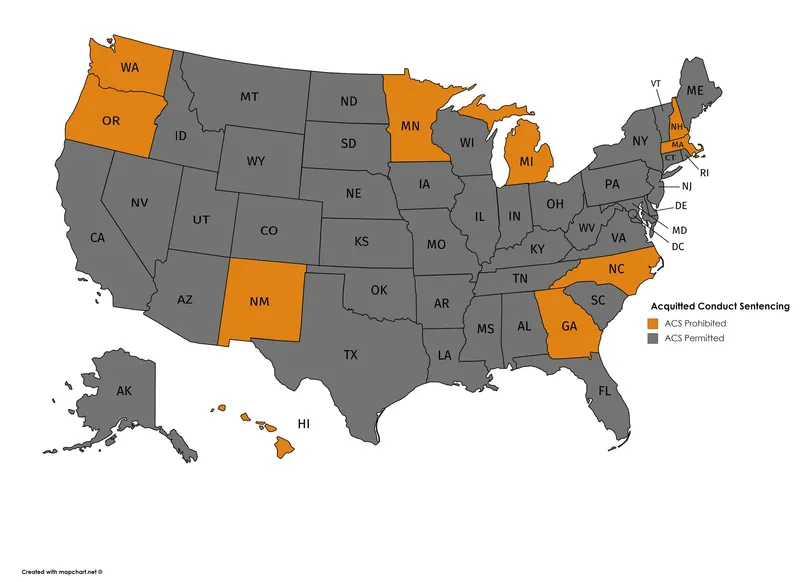
The method of prohibition varies. Georgia, Hawaii, Massachusetts, Michigan, New Hampshire, and North Carolina eliminated the practice via court decision; Minnesota, New Mexico, Oregon, and Washington did so via statutory or regulatory sentencing guidelines. The effect of the prohibitions in these ten states also varies depending on the particular sentencing regime the state employs.
To understand the difficulty that will come with reforming the use of acquitted conduct sentencing at the state level, one needs to understand the various sentencing mechanisms used in the states since they feature substantial variations in both procedure and substance.
Stay tuned for our comprehensive report!